
Milk thermometers
Milk thermometers for steaming and milk foam
A milk thermometer makes it easier to monitor the temperature while heating and steaming milk for cappuccino, caffe latte, flat white, and other coffee drinks.
It is especially useful if you are learning to work with a steam wand and are not yet used to gauging the milk's temperature by touching the milk pitcher.
At Brændeholm Risteri, you will find both analog and digital milk thermometers from brands including Rhino Coffee Gear and Timemore. Many models feature a practical clip, allowing the thermometer to be attached to the milk pitcher during steaming.
A thermometer is not necessary to make good coffee, but it can be a simple tool to make the temperature more reproducible.
See also our selection of milk pitchers for coffee and latte art.
What is a milk thermometer?
A milk thermometer is a temperature measuring instrument that can be used to monitor the milk's temperature during heating and steaming.
Many models consist of a metal probe that is placed in the milk, and either:
-
An analog dial with a temperature display
-
A digital display
Several barista thermometers also feature a clip that makes it possible to attach the thermometer to the edge of the milk pitcher.
This allows you to monitor the temperature while both hands are used for the steaming process itself.
Why use a milk thermometer?
When you are new to milk steaming, it can be hard to know exactly how hot the milk is.
A thermometer gives you a concrete number to work towards.
It can be especially useful if you:
-
Are learning to steam milk
-
Often get the milk hotter than desired
-
Want to repeat the same temperature
-
Work with different types of milk
-
Want to train a more consistent workflow
-
Do not want to judge the temperature solely by hand
Eventually, many home baristas also learn to use the feel of the milk pitcher's temperature as a guide.
Therefore, the thermometer does not have to be something you depend on forever.
What temperature should milk for coffee have?
For many milk-based coffee drinks, approximately 55–65 °C is a practical range to work around.
This does not mean that there is one temperature that is always correct.
The temperature you prefer depends on, among other things:
-
The type of milk
-
The coffee drink
-
Your own taste
-
The amount of milk
-
How the milk is to be served
A milk thermometer makes it easy to experiment.
If, for example, you prefer your milk at around 60 °C, you can try to hit the same level next time and adjust from there.
Analog or digital milk thermometer?
Both types can be used for milk steaming, but the reading process differs.
Analog milk thermometer
An analog thermometer uses a classic dial and normally does not require a battery.
The advantages include:
-
Simple construction
-
No digital screen
-
No battery
-
Easy to keep attached to the milk pitcher
-
Quick overview of the temperature progression
It is a good choice if you want a simple barista thermometer without extra electronics.
Digital milk thermometer
A digital thermometer shows the temperature on an electronic display.
It can be easier to read a precise number quickly.
Depending on the model, there may also be extra features such as temperature alarms or switching between different temperature units.
If you prefer a clear numeric reading, a digital model can be more practical.
Analog or digital – what should I choose?
For general milk steaming, both can work just fine.
Choose analog if you want:
-
Simplicity
-
No batteries
-
Classic dial display
-
A thermometer that is primarily to stay on the milk pitcher during steaming
Choose digital if you prefer:
-
A clear temperature number
-
Digital reading
-
Any extra features on the specific model
It is not necessary to choose the most expensive solution.
For many home baristas, a simple analog thermometer may be more than enough.
Milk thermometer with clip
A clip is particularly practical for milk steaming.
The thermometer is attached to the edge of the milk pitcher so the probe stays in the milk while you work with the steam wand.
This means you don't have to hold the thermometer by hand.
At Brændeholm Risteri, you will find several milk thermometers with clips from both Rhino Coffee Gear and Timemore.
The clip can also help keep the probe positioned in roughly the same place from time to time.
How to position a milk thermometer
The probe must go into the milk so it measures the temperature of the liquid itself.
Avoid letting the tip rest directly against the bottom of the milk pitcher, as you risk measuring the temperature of the metal itself to a greater extent.
Attach the thermometer with the clip if the model has one.
Also ensure that:
-
The probe is sufficiently deep into the milk
-
The display or dial can be read during steaming
-
The thermometer is not in the way of the steam wand
-
The probe is not resting directly against the bottom of the pitcher
The positioning may require some getting used to, especially in smaller milk pitchers.
Short or long milk thermometer?
The length of the probe should roughly match the milk pitcher you are using.
Short milk thermometer
A short thermometer is practical for smaller milk pitchers.
With us, you will find, among others, the Rhino Coffee Gear Short Milk Thermometer at 13 cm.
It can be a good choice if you normally work with smaller pitchers for one cappuccino, flat white, or cortado.
Long milk thermometer
A longer probe can be more practical in larger milk pitchers.
Rhino Coffee Gear Long, for example, has a probe of approximately 18 cm.
Rhino themselves specify the model with an adjustable clip and 18 cm probe.
If you often use a larger milk pitcher, the extra length can make positioning easier.
13 or 18 cm – which length should I choose?
Choose according to the size of your milk pitcher.
For a smaller pitcher around 350 ml, the short model can often be practical.
For larger pitchers around 600 ml, the longer probe can provide better reach.
It is not an absolute rule, because the height and shape of the milk pitcher also matter.
If you have several different milk pitchers, you should choose the thermometer that best fits the pitcher you use the most.
See our selection of milk pitchers in various sizes.
Timemore digital milk thermometer
Timemore's digital thermometer provides a clear electronic temperature reading.
Timemore specifies a measuring range of -20 to 120 °C for the current digital model.
That is much wider than the temperature range you normally use for milk steaming, but it makes the thermometer applicable for more temperature measurements.
For coffee, however, the most important benefit is still the simple option of monitoring the milk's temperature during heating.
Rhino Coffee Gear milk thermometers
Rhino Coffee Gear has several different milk thermometers in its assortment.
At Brændeholm Risteri, you will find, among others:
-
Rhino Short
-
Rhino Long
-
Rhino Digital
The analog models are interesting if you want a simple dial display, while the digital model provides an electronic reading.
Rhino Long has a probe of approximately 18 cm and an adjustable clip, making it suitable for larger milk pitchers.
Milk thermometer for cappuccino
A thermometer can be especially useful while you are learning to steam milk for cappuccino.
For cappuccino, you want both an appropriate temperature and a smooth texture in the milk.
The thermometer can help with the temperature.
However, it does not tell you if you have added the right amount of air or created good microfoam.
You must therefore still work with:
-
The position of the steam wand
-
Air intake
-
Rotation in the milk
-
Milk texture
The thermometer helps with one variable – the temperature.
You can also read our guide to cappuccino.
Milk thermometer for latte art
A thermometer can also be useful when you are practicing latte art.
Latte art requires, above all, fine microfoam that is smooth and pourable.
The temperature is only one part of this.
A milk thermometer can help you stop heating at roughly the same point from time to time, while you concentrate on improving the milk's texture itself.
In this way, you can reduce one variable while you practice the technique.
See also our latte art accessories.
The thermometer cannot measure milk texture
It is important to distinguish between temperature and texture.
A thermometer tells you how hot the milk is.
It does not tell you:
-
How large the air bubbles are
-
Whether you have created microfoam
-
Whether the milk is rotating correctly
-
Whether the foam is too stiff
-
Whether the milk is suitable for latte art
Therefore, the milk thermometer is a training and control tool, not an automatic path to correctly steamed milk.
How to make microfoam?
For traditional steaming, a steam wand and a milk pitcher are used.
At the beginning of the process, a controlled amount of air is added to the milk.
Then, you work with rotation in the pitcher so the air bubbles are distributed throughout the milk.
The goal is a smooth and glossy texture with very small air bubbles.
Here, the thermometer can be used to monitor the temperature while you concentrate on the position of the steam wand and the movement of the milk.
Can I use a milk thermometer for oat drink?
Yes.
The thermometer measures temperature and can therefore also be used with oat drink and other plant-based alternatives.
However, the different products react differently to heating and foaming.
Therefore, you should not automatically use exactly the same temperature and technique for all types of milk and plant drinks.
Use the manufacturer's recommendations as a starting point and adjust according to the product and the coffee drink you are making.
Milk thermometer or temperature sensing by hand?
Experienced baristas often use the feel of the milk pitcher as part of the temperature assessment.
When the pitcher becomes very hot to hold, the milk has typically also reached a relatively high temperature level.
However, it is an imprecise method, especially while you are learning.
A thermometer provides a concrete number and makes it easier to understand the relationship between:
How the pitcher feels → what temperature the milk actually has
After some time, the thermometer can therefore also function as a training tool for your own temperature sense.
Do I need a milk thermometer?
Not necessarily.
If you can already steam milk stably and hit the temperature you prefer, there may not be a problem to solve.
A thermometer is especially relevant for:
-
Beginners
-
Those who often overheat the milk
-
Those who want better reproducibility
-
Those who are training milk steaming
-
Those who want to compare different temperatures
It is a relatively simple and cheap tool, but not a requirement for every coffee station.
Milk thermometer or automatic milk frother?
With an automatic milk frother, the machine often controls the temperature and foaming itself.
Here, a separate thermometer is therefore less necessary.
A milk thermometer makes the most sense when you control the heating yourself, for example with the steam wand on an espresso machine.
If your milk frother already stops automatically at the selected temperature, you normally get less value from yet another temperature measuring tool.
Milk thermometer and milk pitcher
Thermometer and milk pitcher are a natural combination.
The milk pitcher is used for the steaming process itself.
The milk thermometer is used to monitor the temperature along the way.
If you buy both at the same time, be aware of:
-
The height of the pitcher
-
The length of the thermometer
-
Whether the model has a clip
-
Whether the thermometer can be placed without interfering with the steam wand
A very long probe can be impractical in a small pitcher, while a very short probe can be less suitable for a tall pitcher.
Cleaning a milk thermometer
Clean the part of the thermometer that has been in contact with milk after use.
Milk residue should not be allowed to dry on the probe.
For digital models, be aware that the display and electronic components do not necessarily tolerate being submerged in water.
Therefore, always follow the manufacturer's cleaning instructions for the specific model.
Wipe the thermometer off and store it clean and dry between uses.
Can an analog thermometer be calibrated?
Analog thermometers may eventually need verification of their display.
Whether and how a specific model can be calibrated depends on the construction.
Rhino Coffee Gear, for example, offers tools for calibrating their compatible analog thermometers.
If the precision seems suspicious, you should check the thermometer according to the manufacturer's instructions rather than just assuming the temperature is correct.
Milk thermometers at Brændeholm Risteri
At Brændeholm Risteri, you will find both analog and digital milk thermometers for coffee and milk steaming.
The range includes, among others:
-
Short analog milk thermometers
-
Long analog milk thermometers
-
Digital milk thermometers
-
Models with clips for the milk pitcher
-
Rhino Coffee Gear
-
Timemore
Choose first according to the way you work.
If you want simplicity, an analog thermometer may be enough.
If you prefer digital reading, a digital model may be more appropriate.
For the rest of your milk work, you will also find our selection of milk pitchers, milk frothers, and latte art accessories.
See also all our espresso equipment.
Frequently asked questions about milk thermometers
What is a milk thermometer used for?
It is used to measure the milk's temperature during heating and steaming.
What temperature should milk for coffee have?
Around 55–65 °C is a practical working range for many milk-based coffee drinks. The preferred temperature depends, however, on the milk, drink, and personal taste.
Should I choose an analog or digital milk thermometer?
Both types can work just fine. Analog is simple and normally does not require a battery, while digital provides a clear numeric reading.
What is the clip used for?
The clip attaches the thermometer to the milk pitcher so the probe can stay in the milk while you are steaming.
Should the thermometer touch the bottom of the milk pitcher?
No. The probe should measure the milk's temperature and therefore should not rest directly against the bottom of the pitcher.
Is a milk thermometer necessary for latte art?
No. It can help with temperature control, but good microfoam and pouring technique are far more important for latte art.
Can I use the thermometer for oat drink?
Yes. A milk thermometer can also measure the temperature of oat drink and other plant-based alternatives.
What is the difference between a short and a long milk thermometer?
A short thermometer is typically better suited for smaller milk pitchers, while a longer probe can be easier to use in larger pitchers.
Do I need a milk thermometer if my milk frother controls the temperature automatically?
Usually not. The thermometer is most useful when you control the heating yourself, for example with a steam wand.
Can a milk thermometer make the milk better?
Not directly. It helps you control the temperature. The texture of the milk still depends on the actual steaming or frothing technique.
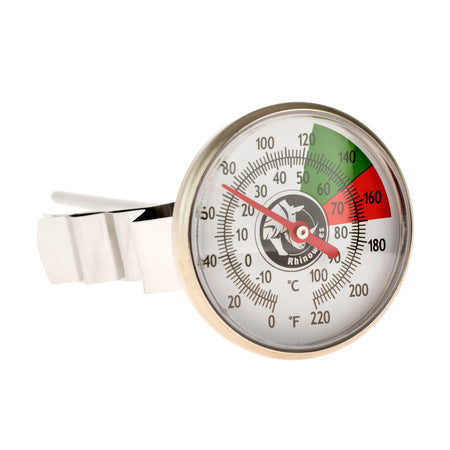
Rhinowares Short Milk Thermometer 13 cm with clip
Original price
89,00 kr
-
Original price
89,00 kr
Original price
89,00 kr
89,00 kr
-
89,00 kr
Current price
89,00 kr
The Rhinowares Short Milk Thermometer is an analog thermometer with a 13 cm probe, designed to monitor milk temperature while steaming. The short v...
View full details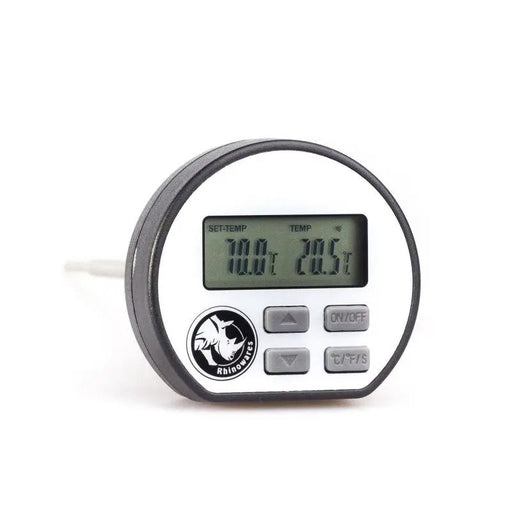
Rhinowares Digital Milk Thermometer
Original price
179,00 kr
-
Original price
179,00 kr
Original price
179,00 kr
179,00 kr
-
179,00 kr
Current price
179,00 kr
Rhinowares Digital Milk ThermometerPractical and user-friendly milk thermometer with a clip that attaches to the milk pitcher.Can measure from -50 ...
View full details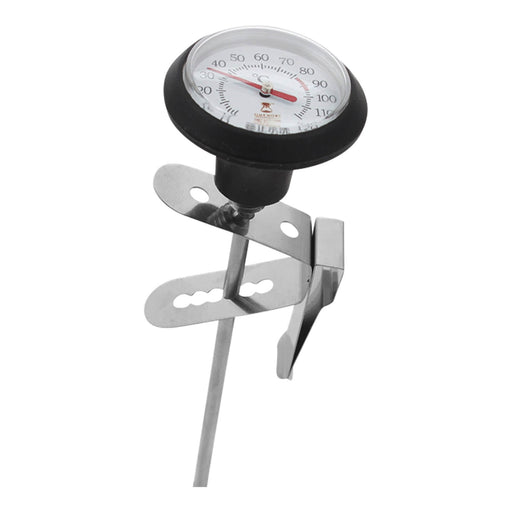
Timemore Milk Thermometer w. Clip
Original price
99,00 kr
-
Original price
99,00 kr
Original price
99,00 kr
99,00 kr
-
99,00 kr
Current price
99,00 kr
Timemore Milk Thermometer w. ClipAnother great product from Timemore.Practical and user-friendly milk thermometer with a clip that attaches to the ...
View full details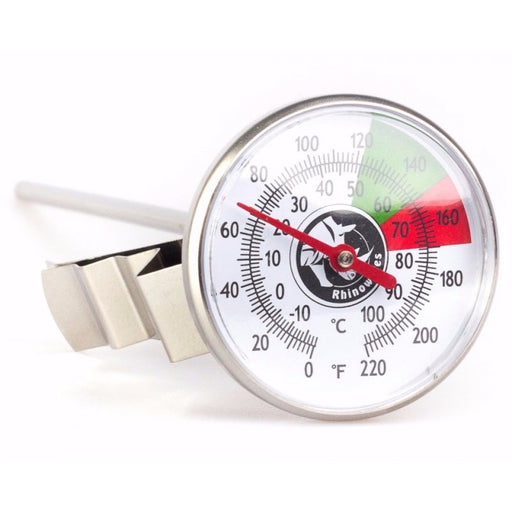
Rhinowares Long Milk Thermometer w. Clip 18 cm
Original price
89,00 kr
-
Original price
89,00 kr
Original price
89,00 kr
89,00 kr
-
89,00 kr
Current price
89,00 kr
Rhinowares Long Milk Thermometer w. clip 180 mmPractical and user-friendly milk thermometer with a clip that attaches to the milk pitcher.Easy-to-r...
View full details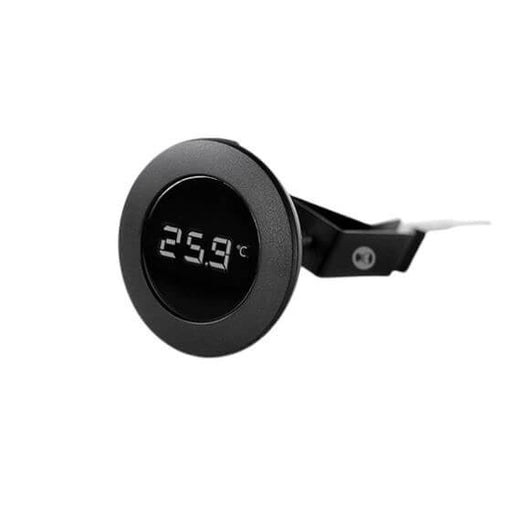
Timemore Digital Milk Thermometer with Clip
Original price
219,00 kr
-
Original price
219,00 kr
Original price
219,00 kr
219,00 kr
-
219,00 kr
Current price
219,00 kr
Timemore Digital Milk Thermometer w. ClipAnother great product from Timemore.Practical and user-friendly milk thermometer with a clip that attaches...
View full detailsMilk thermometers for steaming and milk foam
A milk thermometer makes it easier to monitor the temperature while heating and steaming milk for cappuccino, caffe latte, flat white, and other coffee drinks.
It is especially useful if you are learning to work with a steam wand and are not yet used to gauging the milk's temperature by touching the milk pitcher.
At Brændeholm Risteri, you will find both analog and digital milk thermometers from brands including Rhino Coffee Gear and Timemore. Many models feature a practical clip, allowing the thermometer to be attached to the milk pitcher during steaming.
A thermometer is not necessary to make good coffee, but it can be a simple tool to make the temperature more reproducible.
See also our selection of milk pitchers for coffee and latte art.
What is a milk thermometer?
A milk thermometer is a temperature measuring instrument that can be used to monitor the milk's temperature during heating and steaming.
Many models consist of a metal probe that is placed in the milk, and either:
-
An analog dial with a temperature display
-
A digital display
Several barista thermometers also feature a clip that makes it possible to attach the thermometer to the edge of the milk pitcher.
This allows you to monitor the temperature while both hands are used for the steaming process itself.
Why use a milk thermometer?
When you are new to milk steaming, it can be hard to know exactly how hot the milk is.
A thermometer gives you a concrete number to work towards.
It can be especially useful if you:
-
Are learning to steam milk
-
Often get the milk hotter than desired
-
Want to repeat the same temperature
-
Work with different types of milk
-
Want to train a more consistent workflow
-
Do not want to judge the temperature solely by hand
Eventually, many home baristas also learn to use the feel of the milk pitcher's temperature as a guide.
Therefore, the thermometer does not have to be something you depend on forever.
What temperature should milk for coffee have?
For many milk-based coffee drinks, approximately 55–65 °C is a practical range to work around.
This does not mean that there is one temperature that is always correct.
The temperature you prefer depends on, among other things:
-
The type of milk
-
The coffee drink
-
Your own taste
-
The amount of milk
-
How the milk is to be served
A milk thermometer makes it easy to experiment.
If, for example, you prefer your milk at around 60 °C, you can try to hit the same level next time and adjust from there.
Analog or digital milk thermometer?
Both types can be used for milk steaming, but the reading process differs.
Analog milk thermometer
An analog thermometer uses a classic dial and normally does not require a battery.
The advantages include:
-
Simple construction
-
No digital screen
-
No battery
-
Easy to keep attached to the milk pitcher
-
Quick overview of the temperature progression
It is a good choice if you want a simple barista thermometer without extra electronics.
Digital milk thermometer
A digital thermometer shows the temperature on an electronic display.
It can be easier to read a precise number quickly.
Depending on the model, there may also be extra features such as temperature alarms or switching between different temperature units.
If you prefer a clear numeric reading, a digital model can be more practical.
Analog or digital – what should I choose?
For general milk steaming, both can work just fine.
Choose analog if you want:
-
Simplicity
-
No batteries
-
Classic dial display
-
A thermometer that is primarily to stay on the milk pitcher during steaming
Choose digital if you prefer:
-
A clear temperature number
-
Digital reading
-
Any extra features on the specific model
It is not necessary to choose the most expensive solution.
For many home baristas, a simple analog thermometer may be more than enough.
Milk thermometer with clip
A clip is particularly practical for milk steaming.
The thermometer is attached to the edge of the milk pitcher so the probe stays in the milk while you work with the steam wand.
This means you don't have to hold the thermometer by hand.
At Brændeholm Risteri, you will find several milk thermometers with clips from both Rhino Coffee Gear and Timemore.
The clip can also help keep the probe positioned in roughly the same place from time to time.
How to position a milk thermometer
The probe must go into the milk so it measures the temperature of the liquid itself.
Avoid letting the tip rest directly against the bottom of the milk pitcher, as you risk measuring the temperature of the metal itself to a greater extent.
Attach the thermometer with the clip if the model has one.
Also ensure that:
-
The probe is sufficiently deep into the milk
-
The display or dial can be read during steaming
-
The thermometer is not in the way of the steam wand
-
The probe is not resting directly against the bottom of the pitcher
The positioning may require some getting used to, especially in smaller milk pitchers.
Short or long milk thermometer?
The length of the probe should roughly match the milk pitcher you are using.
Short milk thermometer
A short thermometer is practical for smaller milk pitchers.
With us, you will find, among others, the Rhino Coffee Gear Short Milk Thermometer at 13 cm.
It can be a good choice if you normally work with smaller pitchers for one cappuccino, flat white, or cortado.
Long milk thermometer
A longer probe can be more practical in larger milk pitchers.
Rhino Coffee Gear Long, for example, has a probe of approximately 18 cm.
Rhino themselves specify the model with an adjustable clip and 18 cm probe.
If you often use a larger milk pitcher, the extra length can make positioning easier.
13 or 18 cm – which length should I choose?
Choose according to the size of your milk pitcher.
For a smaller pitcher around 350 ml, the short model can often be practical.
For larger pitchers around 600 ml, the longer probe can provide better reach.
It is not an absolute rule, because the height and shape of the milk pitcher also matter.
If you have several different milk pitchers, you should choose the thermometer that best fits the pitcher you use the most.
See our selection of milk pitchers in various sizes.
Timemore digital milk thermometer
Timemore's digital thermometer provides a clear electronic temperature reading.
Timemore specifies a measuring range of -20 to 120 °C for the current digital model.
That is much wider than the temperature range you normally use for milk steaming, but it makes the thermometer applicable for more temperature measurements.
For coffee, however, the most important benefit is still the simple option of monitoring the milk's temperature during heating.
Rhino Coffee Gear milk thermometers
Rhino Coffee Gear has several different milk thermometers in its assortment.
At Brændeholm Risteri, you will find, among others:
-
Rhino Short
-
Rhino Long
-
Rhino Digital
The analog models are interesting if you want a simple dial display, while the digital model provides an electronic reading.
Rhino Long has a probe of approximately 18 cm and an adjustable clip, making it suitable for larger milk pitchers.
Milk thermometer for cappuccino
A thermometer can be especially useful while you are learning to steam milk for cappuccino.
For cappuccino, you want both an appropriate temperature and a smooth texture in the milk.
The thermometer can help with the temperature.
However, it does not tell you if you have added the right amount of air or created good microfoam.
You must therefore still work with:
-
The position of the steam wand
-
Air intake
-
Rotation in the milk
-
Milk texture
The thermometer helps with one variable – the temperature.
You can also read our guide to cappuccino.
Milk thermometer for latte art
A thermometer can also be useful when you are practicing latte art.
Latte art requires, above all, fine microfoam that is smooth and pourable.
The temperature is only one part of this.
A milk thermometer can help you stop heating at roughly the same point from time to time, while you concentrate on improving the milk's texture itself.
In this way, you can reduce one variable while you practice the technique.
See also our latte art accessories.
The thermometer cannot measure milk texture
It is important to distinguish between temperature and texture.
A thermometer tells you how hot the milk is.
It does not tell you:
-
How large the air bubbles are
-
Whether you have created microfoam
-
Whether the milk is rotating correctly
-
Whether the foam is too stiff
-
Whether the milk is suitable for latte art
Therefore, the milk thermometer is a training and control tool, not an automatic path to correctly steamed milk.
How to make microfoam?
For traditional steaming, a steam wand and a milk pitcher are used.
At the beginning of the process, a controlled amount of air is added to the milk.
Then, you work with rotation in the pitcher so the air bubbles are distributed throughout the milk.
The goal is a smooth and glossy texture with very small air bubbles.
Here, the thermometer can be used to monitor the temperature while you concentrate on the position of the steam wand and the movement of the milk.
Can I use a milk thermometer for oat drink?
Yes.
The thermometer measures temperature and can therefore also be used with oat drink and other plant-based alternatives.
However, the different products react differently to heating and foaming.
Therefore, you should not automatically use exactly the same temperature and technique for all types of milk and plant drinks.
Use the manufacturer's recommendations as a starting point and adjust according to the product and the coffee drink you are making.
Milk thermometer or temperature sensing by hand?
Experienced baristas often use the feel of the milk pitcher as part of the temperature assessment.
When the pitcher becomes very hot to hold, the milk has typically also reached a relatively high temperature level.
However, it is an imprecise method, especially while you are learning.
A thermometer provides a concrete number and makes it easier to understand the relationship between:
How the pitcher feels → what temperature the milk actually has
After some time, the thermometer can therefore also function as a training tool for your own temperature sense.
Do I need a milk thermometer?
Not necessarily.
If you can already steam milk stably and hit the temperature you prefer, there may not be a problem to solve.
A thermometer is especially relevant for:
-
Beginners
-
Those who often overheat the milk
-
Those who want better reproducibility
-
Those who are training milk steaming
-
Those who want to compare different temperatures
It is a relatively simple and cheap tool, but not a requirement for every coffee station.
Milk thermometer or automatic milk frother?
With an automatic milk frother, the machine often controls the temperature and foaming itself.
Here, a separate thermometer is therefore less necessary.
A milk thermometer makes the most sense when you control the heating yourself, for example with the steam wand on an espresso machine.
If your milk frother already stops automatically at the selected temperature, you normally get less value from yet another temperature measuring tool.
Milk thermometer and milk pitcher
Thermometer and milk pitcher are a natural combination.
The milk pitcher is used for the steaming process itself.
The milk thermometer is used to monitor the temperature along the way.
If you buy both at the same time, be aware of:
-
The height of the pitcher
-
The length of the thermometer
-
Whether the model has a clip
-
Whether the thermometer can be placed without interfering with the steam wand
A very long probe can be impractical in a small pitcher, while a very short probe can be less suitable for a tall pitcher.
Cleaning a milk thermometer
Clean the part of the thermometer that has been in contact with milk after use.
Milk residue should not be allowed to dry on the probe.
For digital models, be aware that the display and electronic components do not necessarily tolerate being submerged in water.
Therefore, always follow the manufacturer's cleaning instructions for the specific model.
Wipe the thermometer off and store it clean and dry between uses.
Can an analog thermometer be calibrated?
Analog thermometers may eventually need verification of their display.
Whether and how a specific model can be calibrated depends on the construction.
Rhino Coffee Gear, for example, offers tools for calibrating their compatible analog thermometers.
If the precision seems suspicious, you should check the thermometer according to the manufacturer's instructions rather than just assuming the temperature is correct.
Milk thermometers at Brændeholm Risteri
At Brændeholm Risteri, you will find both analog and digital milk thermometers for coffee and milk steaming.
The range includes, among others:
-
Short analog milk thermometers
-
Long analog milk thermometers
-
Digital milk thermometers
-
Models with clips for the milk pitcher
-
Rhino Coffee Gear
-
Timemore
Choose first according to the way you work.
If you want simplicity, an analog thermometer may be enough.
If you prefer digital reading, a digital model may be more appropriate.
For the rest of your milk work, you will also find our selection of milk pitchers, milk frothers, and latte art accessories.
See also all our espresso equipment.
Frequently asked questions about milk thermometers
What is a milk thermometer used for?
It is used to measure the milk's temperature during heating and steaming.
What temperature should milk for coffee have?
Around 55–65 °C is a practical working range for many milk-based coffee drinks. The preferred temperature depends, however, on the milk, drink, and personal taste.
Should I choose an analog or digital milk thermometer?
Both types can work just fine. Analog is simple and normally does not require a battery, while digital provides a clear numeric reading.
What is the clip used for?
The clip attaches the thermometer to the milk pitcher so the probe can stay in the milk while you are steaming.
Should the thermometer touch the bottom of the milk pitcher?
No. The probe should measure the milk's temperature and therefore should not rest directly against the bottom of the pitcher.
Is a milk thermometer necessary for latte art?
No. It can help with temperature control, but good microfoam and pouring technique are far more important for latte art.
Can I use the thermometer for oat drink?
Yes. A milk thermometer can also measure the temperature of oat drink and other plant-based alternatives.
What is the difference between a short and a long milk thermometer?
A short thermometer is typically better suited for smaller milk pitchers, while a longer probe can be easier to use in larger pitchers.
Do I need a milk thermometer if my milk frother controls the temperature automatically?
Usually not. The thermometer is most useful when you control the heating yourself, for example with a steam wand.
Can a milk thermometer make the milk better?
Not directly. It helps you control the temperature. The texture of the milk still depends on the actual steaming or frothing technique.


