




Tamping mats and tamping stations for espresso
A tamping mat or tamping station provides a stable workspace when preparing your portafilter for espresso.
A tamping mat – also called a tamper mat – protects the countertop and provides a non-slip surface for tamping. A tamping station goes a step further and typically provides a fixed position for the portafilter and, in some cases, the tamper, distributor, or other espresso accessories.
At Brændeholm Risteri, you will find tamping mats, tamping stations, and tamper holders for the home barista and coffee station.
What is a tamping mat?
A tamping mat is a mat placed on the table in front of the espresso machine.
When the portafilter needs to be tamped, it can rest on the mat instead of directly against the kitchen counter.
A tamping mat has three primary functions:
• Protects the countertop
• Provides a non-slip workspace
• Provides a softer base for the portafilter
It is a very simple piece of espresso equipment, but if you make espresso every day, it can make your workspace more practical.
Tamping mat or tamper mat?
You will encounter several different names for essentially the same product.
In English webshops, you will often see:
Tamping mat
or
Tamper mat
There may be differences in the shape and construction of individual models, but the terms are often used for the same type of surface for tamping espresso.
Why use a tamping mat?
When you tamp, you apply force to the portafilter.
If the portafilter rests directly against a hard countertop, both the table and the portafilter can be strained or get marked over time.
A rubber or silicone mat creates a protective layer between the equipment and the table.
The non-slip surface can also make it easier to keep the portafilter stable during tamping.
This is especially useful on slippery kitchen countertops.
Tamping mat for the edge of the table
Some tamping mats are flat.
Others are designed so that part of the mat hangs over the edge of the countertop.
This construction can be practical if you prefer to place the portafilter close to the table edge during tamping.
The downward-curving part also protects the edge of the countertop itself.
Which shape you should choose depends mostly on how your coffee corner is set up.
What is a tamping station?
A tamping station is a more fixed solution for espresso preparation.
Instead of just placing the portafilter on a mat, the station has a specific spot where the portafilter can rest during tamping.
Some models also have separate slots for, for example:
• Tamper
• Distributor
• WDT tool
• Other small espresso utensils
This can make your coffee station more organized and gather the tools you use for every espresso.
Tamping mat or tamping station?
Both can be good solutions.
The choice depends primarily on your workspace.
Choose a tamping mat if you:
Want a simple solution
Have limited space
Want to protect the countertop
Want to be able to move the equipment easily
Prefer a solution that is easy to clean
Choose a tamping station if you:
- Want a fixed coffee station
- Want a specific position for the portafilter
- Want to organize your tamper and other equipment
- Have space next to the espresso machine
- Prefer a more permanent setup
There is no brewing requirement that you must use one over the other.
The most important thing is that the portafilter is stable and that you can tamp straight and in a controlled manner.
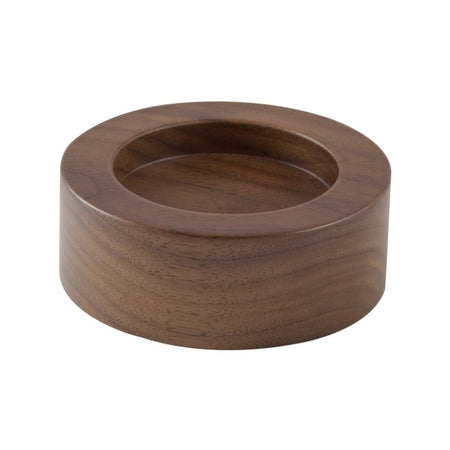
What is a tamper holder?
A tamper holder is primarily intended for storing the tamper.
It gives the tamper a fixed spot between espressos while protecting the countertop from direct contact with the base of the tamper.
A tamper holder is therefore not necessarily the same as a tamping station.
Tamper holder
Primarily holds the tamper.
Tamping mat
Provides a protective workspace.
Tamping station
Typically holds or supports the portafilter during tamping and may also have room for other tools.
It is worth distinguishing between the three when choosing equipment.
Tamping station with room for a tamper and distributor
A larger tamping station can be interesting if you use multiple tools in your puck preparation.
The workflow might, for example, consist of:
Grinding
↓
WDT/distribution
↓
Tamping
↓
Brewing
If the tamper and distributor have fixed positions right next to the portafilter, the workflow becomes more organized.
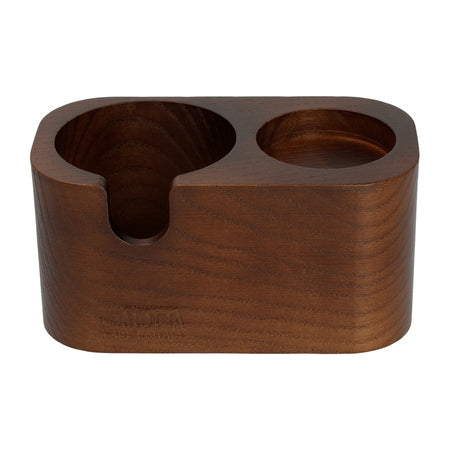
The Motta tamping stations in our range include models with multiple holder positions, so there can be room for both the portafilter and extra tools.
Always check the dimensions of the individual model if you want to be sure that your equipment fits.
Wooden tamping station
A wooden tamping station provides a different look than a traditional rubber mat.
It functions both as practical espresso equipment and as a more permanent part of the coffee corner.
Wood fits especially well if you want to have your tamper, portafilter, and other tools gathered in a station next to the espresso machine.
However, a wooden station requires a bit more space than a simple tamping mat.
If your coffee corner is very compact, a regular mat might therefore be more practical.
Rubber or silicone tamping mat
Rubber and silicone are popular materials for tamping mats because they can create a relatively non-slip and resilient surface.
The advantage is mainly that the mat:
doesn't take up much space
is easy to move
protects the work surface
and is usually easy to wipe off.
Coffee grounds almost inevitably end up around the espresso grinder and portafilter, so a surface that is easy to clean is practical.
What size tamping mat should I choose?
It depends first and foremost on the space around your espresso machine.
A small tamping mat is good if you only want space for the portafilter and the tamper.
A larger mat can provide space for:
portafilter
tamper
distributor
WDT tool
dosing funnel
and possibly other tools.
However, bigger is not automatically better.
If you have a compact coffee corner, a smaller mat can provide a tidier setup.
Does the tamping mat need to fit 51, 54, or 58 mm?
A standard flat tamping mat is usually not dependent on the tamper diameter itself.
Therefore, you can often use the same mat regardless of whether your espresso machine uses, for example:
51 mm
53–54 mm
or
58 mm
For tamping stations and tamper holders, however, compatibility is more relevant.
Here there may be physical cutouts or holders with specific dimensions.
Therefore, check the product description for the individual tamping station or holder.
Tamping mat for Sage
If you have a Sage espresso machine, you do not necessarily need a tamping mat from Sage.
A regular tamping mat can be used as long as the portafilter can be placed stably on it.
Sage machines with a 54 mm portafilter can therefore easily be combined with many universal tamping mats.
With a tamping station, you must to a greater extent check how the portafilter is supported.
Tamping mat for 58 mm espresso machine
The same applies to professional 58 mm portafilters.
A regular flat tamper mat can be used regardless of the tamper's diameter.
If you choose a station with fixed holder positions, you must check compatibility.
The Motta stations in our current range include models where the holder positions can be used for tools up to 58 mm.
How to tamp espresso
Once the coffee is distributed in the filter basket, place the portafilter on a stable surface.
Place the tamper horizontally on top of the coffee bed.
Press down in a controlled manner while trying to keep the tamper straight.
When the coffee bed has been compressed, remove the tamper.
The most important thing is not to turn tamping into a test of strength.
Focus especially on:
Uniform distribution before tamping
A straight tamp
A reproducible workflow
This makes it easier to compare your espressos and adjust the grinder systematically.
How hard should you tamp espresso?
You will often see recommendations for, for example, 10, 15, or 20 kg of pressure.
However, you do not need to try to hit a magic number every time.
Once the coffee bed is sufficiently compressed, extra force is much less interesting than being able to repeat the process and keep the tamper straight.
A calibrated or spring-loaded tamper can be useful if you want to make the workflow more consistent.
But a standard tamper can definitely be used.
The most important thing is to tamp straight
An uneven tamp results in an uneven coffee puck.
Therefore, you should try to keep the base of the tamper parallel to the filter basket.
A tamping station or stable tamping mat can help by providing a more controlled work surface.
Watch the tamper from the side as you press down until the movement feels natural.
Once the technique is ingrained, tamping does not need to take more than a few seconds.
Should you turn the tamper after tamping?
It is not necessary to perform a heavy "polishing" by turning the tamper around after tamping.
Instead, focus on a clean, straight tamp.
If you turn the tamper significantly under pressure, you risk disturbing the surface of the puck.
Therefore, lift the tamper in a controlled manner after tamping.
WDT before or after tamping?
WDT is used before tamping.
A typical workflow is:
- Grind the coffee into the filter basket.
- Use a dosing funnel if necessary.
- Distribute the coffee with WDT.
- Remove the funnel.
- Tamp the coffee.
- Insert the portafilter into the espresso machine.
- Brew the espresso.
Once the coffee is tamped, you should not start poking around in the puck with WDT needles.
Distributor before or after tamping?
If you use an espresso distributor, it is also used before the final tamping.
The purpose is to create a more uniform coffee bed before it is compressed.
Some home baristas use:
WDT
distributor
tamper.
Others only use:
WDT
tamper.
You do not necessarily need all the tools to make good espresso.
Do you need both WDT and a distributor?
No.
WDT can be an effective way to break up clumps and distribute coffee in the filter basket.
A distributor primarily works with the surface and the positioning of the coffee bed.
Many home baristas today therefore choose to simply use a good WDT technique followed by a straight tamp.
If you already get consistent results without a distributor, there is no reason to add a tool just for the sake of having more equipment.
Why is distribution important before tamping?
The tamper can compress the coffee bed, but it cannot necessarily fix poor distribution deep inside the filter basket.
If significantly more coffee lies on one side of the basket than the other, you may end up with an uneven coffee bed.
Therefore, it makes sense to distribute the coffee evenly first and then tamp.
Tamping should be the final compression – not the actual distribution process.
Tamping mat for the home barista
A tamping mat is one of the simpler pieces of espresso accessories.
If you have just started with espresso, you do not need a large professional tamping station.
A simple non-slip mat may be plenty.
When your coffee corner later grows with:
WDT
distributor
more tampers
dosing funnels
and other espresso equipment,
an organized tamping station can become more interesting.
Tamping station for an organized coffee corner
If you make espresso daily, having fixed spots for your equipment can make the workflow more manageable.
You know where the tamper is.
The portafilter has a fixed place during tamping.
The WDT or distributor is placed next to it.
It does not automatically result in better espresso, but it can make the process more pleasant and reproducible.
And a tidy coffee corner is not a bad bonus.
Motta tamping mats and tamping stations
In our selection, you will find several solutions from the Italian brand Motta.
This includes, among other things:
tamping mats
wooden tamping stations
tamper holders
and tamper stands.
This makes it possible to choose between a very simple tamping mat and a more permanent station with room for multiple tools.
See the specifications for each individual product for dimensions and compatibility.
Espresso Gear tamping mat
We also carry tamping mats from Espresso Gear.
This provides an alternative to Motta if you primarily want a simple mat rather than a larger station.
When comparing models, we would especially look at:
Size
Material
Shape
Placement on the table
and
the way you normally hold the portafilter during tamping.
The brand is less important than whether the mat fits your workflow.
How do you clean a tamping mat?
Coffee grounds gather quickly around the tamping area.
Therefore, wipe the mat off regularly.
On many rubber and silicone mats, loose coffee grounds can simply be brushed or rinsed away.
The specific cleaning method, however, depends on the material.
A wooden station should obviously not be treated the same way as a loose rubber mat.
Therefore, follow the instructions for the individual product.
Should you clean the tamper?
Yes.
The flat underside of the tamper can accumulate coffee grounds and coffee oils.
Therefore, wipe it off as needed.
Especially if the tamper is damp, coffee can get stuck on the underside.
A clean and dry tamper also provides a more consistent workspace.
Which espresso equipment should be at the tamping station?
A simple setup might consist of:
Tamping mat or tamping station
You do not need to buy everything at once.
To begin with, a good coffee grinder, a correct tamper, a scale, and a stable tamping surface are more important than a large collection of specialty tools.
How to choose a tamping mat or tamping station
If you want the simplest solution:
Choose a tamping mat.
If you want a fixed place for the portafilter:
Choose a tamping station.
If you just want a place to set your tamper:
Choose a tamper holder or tamper stand.
If space is limited:
Choose a compact mat.
If you have a permanent coffee corner:
Consider a larger tamping station with room for more tools.
The most important thing is not which solution looks the most professional.
The most important thing is that it fits your portafilter, your workspace, and your way of making espresso.
Frequently asked questions about tamping mats and tamping stations
What is a tamping mat?
A tamping mat is a protective and non-slip surface used under the portafilter when tamping coffee for espresso.
What is a tamper mat?
Tamper mat is the English term often used for a tamping mat.
What is a stampemåtte?
A tamping mat is another Danish term for a tamping mat. The products are used as a base when tamping espresso.
What is the difference between a tamping mat and a tamping station?
A tamping mat is a flat or shaped base. A tamping station usually has a fixed position or support for the portafilter and may also have space for other espresso tools.
Do I need a tamping mat?
No, but it can protect your countertop and provide a more stable and non-slip workspace.
How hard should espresso be tamped?
Use a firm and reproducible pressure. It is more important to get the coffee bed compressed and tamp level than to try to hit a specific number of kilograms every time.
Should the tamper be completely level?
Yes. A level tamp is a good goal because the coffee puck should have an even surface before brewing.
Is WDT used before tamping?
Yes. WDT is used to distribute the ground coffee before the final tamp.
Does a tamping mat fit 54 and 58 mm?
A regular flat tamping mat is usually not dependent on the tamper diameter. For tamping stations and holders, you should check the specific measurements.
Is a tamper holder the same as a tamping station?
No. A tamper holder is primarily intended for storing the tamper, while a tamping station also usually supports the portafilter during tamping.


