



Dosing accessories for coffee and espresso
Dosing accessories make it easier to weigh, transfer, and distribute coffee without unnecessary waste – both when working with espresso and other brewing methods.
At Brændeholm Risteri, you will find various types of dosing equipment, including dosing funnels, dosing bowls, dosing cups, and dosing spoons.
The different products do not solve the same problem. For example, a dosing funnel helps keep ground coffee in the portafilter, while a dosing bowl or dosing cup can be used to weigh and transfer coffee beans or ground coffee.
You therefore do not need all dosing equipment. Choose what fits the way you work with coffee.
See also our full selection of espresso equipment.
What are dosing accessories?
Dosing is fundamentally about controlling how much coffee you use for a brew.
It can be coffee beans that are weighed before grinding, or ground coffee that needs to be transferred to a portafilter without ending up on the table.
Dosing accessories can therefore be used for different parts of the process.
The most common types are:
- dosing funnels
- dosing bowls
- dosing cups
- dosing spoons
- coffee scales
Which solution is most relevant depends on your coffee grinder, brewing method, and workflow.
Dosing funnel for espresso
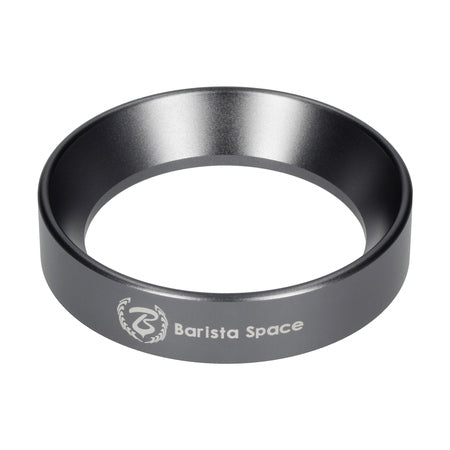
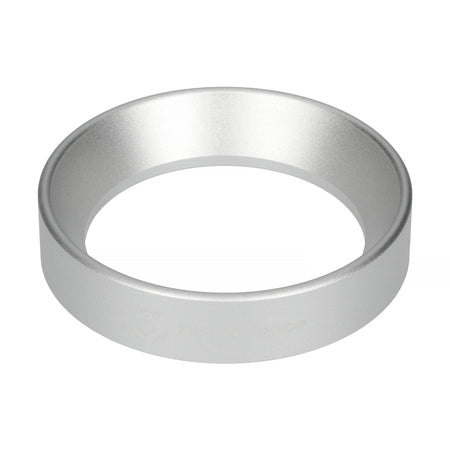
A dosing funnel is placed on top of the portafilter.
The funnel increases the rim around the filter basket and makes it easier to get the ground coffee into the basket without spilling coffee over the sides.
This is especially practical if you:
- grind directly into the portafilter
- transfer coffee from a dosing cup
- use WDT
- work with a relatively high dose of coffee
- often get coffee grounds on the table
A dosing funnel is therefore primarily a tool for a cleaner and easier workflow.
Magnetic dosing funnel
A magnetic dosing funnel is held securely against the portafilter using magnets.
This can be practical during both grinding and distribution, because the funnel stays on the portafilter while you work.
It is particularly useful together with WDT tools.
When the needles move through the ground coffee, the funnel helps prevent coffee grounds from being pushed over the edge of the filter basket.
Once distribution is finished, the funnel is removed, after which the coffee can be tamped.
Which size dosing funnel should I choose?
The dosing funnel must fit your portafilter.
At Brændeholm Risteri, you will find funnels for different sizes, including models intended for smaller portafilters and models for 58 mm.
You should not only choose based on the brand of your espresso machine.
Always check the compatibility of the specific product, as portafilters and filter baskets can vary between machines and models.
The same principle applies to other size-dependent espresso equipment, such as tampers and precision baskets.
Dosing funnel and WDT
Dosing funnels and WDT go naturally together.
WDT – Weiss Distribution Technique involves using thin needles to break up clumps and distribute the ground coffee in the filter basket.
When the coffee is processed with WDT, coffee grounds can easily move over the edge of the portafilter.
Here, the dosing funnel acts as a raised rim around the basket.
When distribution is finished, the funnel is removed, and the coffee bed can be tamped with a suitable tamper.
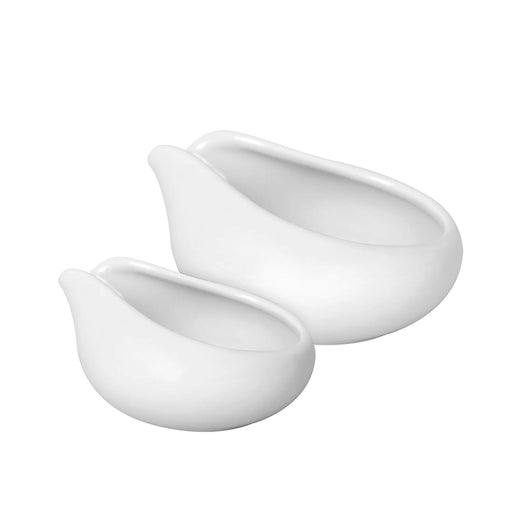
What is a dosing bowl?
A dosing bowl is used to hold and transfer a measured portion of coffee beans or ground coffee.
It is especially practical if you weigh each portion of coffee separately before grinding.
For example, you can:
- place the bowl on a coffee scale
- weigh the desired amount of coffee beans
- pour the beans into the coffee grinder
- grind the coffee for the desired brewing method
The dosing bowl can thus function as a simple link between the coffee container, scale, and grinder.
Dosing bowl for single dosing
Dosing bowls are particularly practical in a single dose setup.
Here, you do not necessarily store a large amount of coffee beans in the grinder's hopper. Instead, you weigh the desired portion for each brew and pour only this amount into the grinder.
This makes it easy to switch between different coffee beans and keep track of the amount of coffee you use.
It can be relevant for both espresso and filter coffee.
A coffee scale is of course especially useful in this workflow.
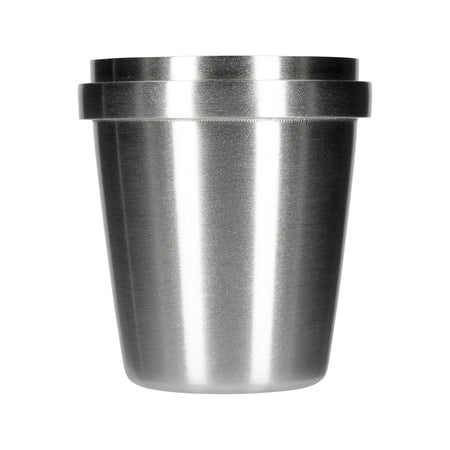
What is a dosing cup?
A dosing cup has a similar purpose to a dosing bowl, but the shape is typically developed for easy transfer between grinder and portafilter.
For example, you can grind the coffee directly into the cup and then transfer the coffee to the filter basket.
This can be practical on coffee grinders where it is easier to place a cup than a portafilter directly under the outlet.
A dosing cup can also be used to weigh coffee beans before grinding.
Dosing cup or dosing bowl?
They overlap quite a bit.
A dosing bowl is especially practical for weighing and pouring whole coffee beans.
A dosing cup can be practical both before and after grinding and is often shaped so that ground coffee can more easily be transferred to a portafilter.
This does not mean that you need both.
If you mainly weigh beans before grinding, a bowl may be sufficient.
If you also want to collect ground coffee from the grinder and transfer it to the portafilter, a dosing cup may be more practical.
Dosing spoon for coffee
A dosing spoon is the simplest way to move a roughly fixed amount of coffee.
It can be practical for, for example, filter coffee, where you want a quick and simple workflow without weighing every single brew.
A spoon is, however, not the same as a precision scale.
How much coffee actually fills a given spoon can vary depending on, among other things, the shape and density of the coffee.
If you want to be able to repeat a recipe more accurately, a coffee scale is therefore a better reference.
Coffee scale or dosing spoon?
It depends on how accurately you want to work.
A dosing spoon is:
quick and simple.
A coffee scale is:
more accurate and easier to repeat from brew to brew.
For espresso, I would generally recommend using a scale because relatively small changes in dose can affect the brew.
For regular filter coffee, a spoon can be practical if simplicity matters more to you than precise reproducibility.
Why weigh coffee beans before grinding?
When you weigh the coffee beans before grinding, you know how much coffee you are starting with.
It makes it easier to work with a fixed recipe.
It is especially useful if you want to compare different grind settings, coffee beans, or brewing methods.
If the coffee amount changes randomly from brew to brew, it becomes more difficult to assess what actually changed the taste.
A fixed dose therefore provides a better starting point for adjustment.
Dosing espresso
With espresso, the dose is only one of several variables.
The result is also affected by, among other things:
- grind size
- the amount of espresso in the cup
- brew time
- the coffee bean
- the filter basket
The most important thing is therefore not to find one universal number of grams that fits all machines.
Instead, start with the dose that fits your filter basket and recipe, and keep it stable while you adjust other parameters.
You can find coffee with different taste profiles in our selection of coffee beans for espresso.
Dosing for filter coffee
Dosing is at least as relevant for filter coffee.
Here, you typically work with a specific ratio between the amount of coffee and water.
By weighing both coffee and water, it becomes easier to repeat a brew you are satisfied with.
This applies to, among others, Hario V60, Chemex, Hario Switch, and other manual brewing methods.
Therefore, dosing accessories are not only relevant for espresso.
Dosing equipment and coffee grinder
Dosing and grinding are closely linked.
With single dosing, the coffee beans are weighed first and then poured into the grinder.
At Brændeholm Risteri, you will find both electric coffee grinders and manual coffee grinders.
Which grinder type fits best depends on, among other things, the brewing method, desired capacity, and how much you want to work manually.
Dosing bowls or dosing cups can be used with both types.
Which dosing accessory should I choose?
If you primarily make espresso, a dosing funnel will often be one of the most practical choices, especially if you use WDT or grind directly into the portafilter.
If you work with single dosing, a dosing bowl or dosing cup is practical for weighing and moving coffee beans.
If you want a quick and simple dose for filter coffee, a dosing spoon may be sufficient.
If the goal is the greatest possible reproducibility, a coffee scale is the best starting point.
You do not need to buy all types.
Choose the product that removes a specific annoyance in your current workflow.
Dosing accessories for the home barista
A good home setup does not have to consist of a long series of special tools.
For espresso, a workflow could, for example, be:
Weigh beans → grind → dose into portafilter → distribute with WDT → tamp → brew
Here, different products can help at different points in the process.
A dosing bowl helps with the initial weighing.
A dosing cup can help with the transfer from the grinder.
A dosing funnel can keep the coffee in the portafilter during distribution.
A WDT tool helps with the distribution.
A tamper completes the puck preparation before brewing.
The point is not to use as many tools as possible, but to create a simple workflow that you can repeat.
Keep dosing accessories clean
Equipment that comes into contact with coffee should be cleaned regularly.
Wipe coffee grounds and dust away from funnels, cups, and bowls after use.
If the product can be washed, you should follow the manufacturer's instructions for the material.
This is especially true for dosing equipment in wood or other materials that do not necessarily need to be treated in the same way as stainless steel or ceramics.
Dosing accessories at Brændeholm Risteri
At Brændeholm Risteri, you will find various solutions for dosing coffee.
You can, among other things, go directly to:
Dosing funnels – for portafilter and espresso.
Dosing bowls – for weighing and transferring coffee beans.
Coffee scales – when you want to work accurately with both coffee and water.
WDT tools – for distributing ground coffee in the filter basket.
Tampers – for the next step after distribution.
In this way, you can build up your coffee station as needed rather than buying equipment you won't use.
Frequently asked questions about dosing accessories
What are dosing accessories?
Dosing accessories are tools that help weigh, move, or handle coffee beans and ground coffee. This includes dosing funnels, dosing bowls, dosing cups, and dosing spoons.
What is a dosing funnel used for?
A dosing funnel is placed on top of the portafilter and helps keep the ground coffee in the filter basket during grinding and distribution.
Which size dosing funnel should I choose?
The funnel must fit your portafilter and its specific construction. Always check compatibility on the product page before purchasing.
What is a dosing bowl used for?
It is typically used to weigh a portion of coffee beans and pour them into the coffee grinder.
What is the difference between a dosing cup and a dosing bowl?
They can both be used for weighing and transferring. Dosing cups are often particularly practical for collecting ground coffee and transferring it to a portafilter.
Do I need to use a coffee scale?
It is not a requirement, but a scale provides significantly better opportunities to repeat the same dose from brew to brew.
Is a dosing funnel necessary for WDT?
No, but it can be very practical because it helps keep the coffee grounds in the filter basket while you work with WDT.
Can dosing accessories be used for filter coffee?
Yes. Dosing bowls, dosing spoons, and coffee scales can also be used for filter coffee and other brewing methods.
Is single dosing only for espresso?
No. You can weigh coffee beans individually before grinding for both espresso, filter coffee, AeroPress, and other brewing methods.
Should I buy both a dosing cup and a dosing bowl?
Not necessarily. They have overlapping functions. Choose the shape and workflow that best suits your grinder and brewing method.


