



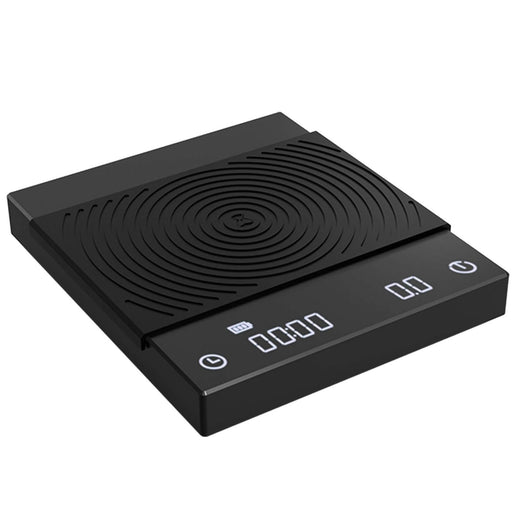
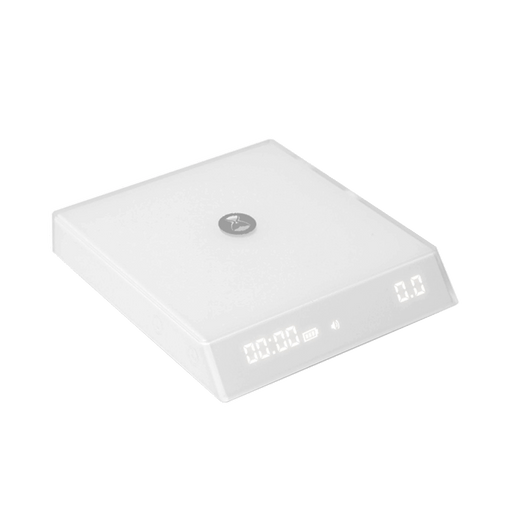

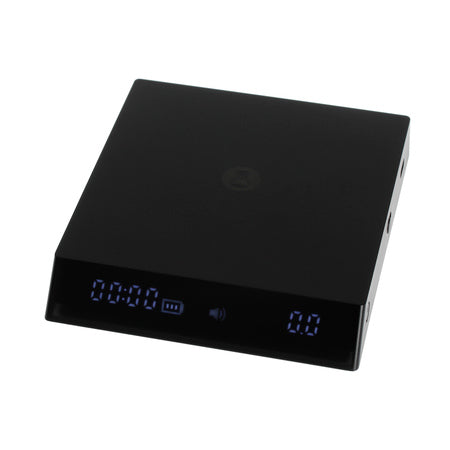

Coffee scales for espresso, pour over and filter coffee
A good coffee scale makes it easier to dose precisely and repeat the same brewing recipe every time.
At Brændeholm Risteri you will find digital coffee scales for, among others, espresso, Hario V60, Chemex, AeroPress and regular filter coffee. The range includes both compact espresso scales and larger coffee scales with timers and features for manual coffee brewing.
Which coffee scale you should choose depends primarily on how you brew your coffee.
Which coffee scale should I choose?
For espresso, a compact coffee scale with a fast response time is particularly practical.
For pour over, a larger platform, a timer, and good capacity are often more important.
If you want to use the same scale for multiple brewing methods, you should find a model that is small enough for the espresso machine but still has room for your regular filter brewer or serving carafe.
As a starting point, you can look for:
• 0.1 gram resolution
• Built-in timer
• Fast response time
• Tare function
• Clear display
• Appropriate maximum capacity
• A size that fits your coffee equipment
More advanced coffee scales may also have automatic brewing modes, flow rate, and other features.
Coffee scale for espresso
With espresso, you work with relatively small amounts of coffee and liquid.
A common starting point could for example be:
18 g coffee in → 36 g espresso out
Here, a scale with 0.1 gram resolution makes it easier to control both dosage and yield.
A fast response time is also important. The espresso continues to flow while the scale registers changes, and a slow scale can therefore make it harder to stop the brewing at the desired weight.
What you should look for in an espresso scale
A good espresso scale should especially be:
Compact
It must be able to fit on the espresso machine's drip tray along with the cup.
Low
A low profile provides more space between the portafilter and the cup.
Fast
The display must react quickly to changes in weight.
Precise
0.1 gram resolution is a good starting point.
With timer
This allows you to track both the brewing time and the espresso weight on the same display.
Some models can also automatically detect when the espresso starts flowing and start the timer.
Coffee scale for Hario V60 and pour over
For pour over, the scale is not only used for the coffee beans.
You also weigh the water while pouring.
A typical V60 recipe could for example be:
15 g coffee
250 g water
Here, the V60, cup, or serving carafe is placed directly on the coffee scale. After taring, you can track the water amount during the entire brewing process.
A coffee scale with a timer is therefore particularly practical for pour over.
You can keep an eye on:
• Coffee dosage
• Bloom
• Water volume
• Pours
• Total brewing time
Some coffee scales can also show flow rate, i.e., how many grams of water you are pouring per second.
It is not necessary to brew good coffee, but it can be useful if you want to work very systematically with your pouring technique.
Coffee scale for Chemex
For Chemex, many of the same principles as with V60 apply.
The difference is that the Chemex and the water together can weigh significantly more.
Therefore, you should check the coffee scale's maximum capacity if you brew large portions.
A coffee scale for Chemex should have:
• A sufficiently large platform
• High enough maximum capacity
• Timer
• Clear display
If you brew, for example, 750 ml or 1 liter of coffee, the scale must be able to support both the Chemex carafe, the filter, the coffee, and the water.
Coffee scale for AeroPress
A coffee scale makes AeroPress recipes much easier to repeat.
You can, for example, work with:
15 g coffee
250 g water
and a specific brewing time.
Place the AeroPress and cup on the scale, use the tare function, and add the desired amount of water.
For AeroPress, you normally do not need the same compact construction as for espresso, so most standard coffee scales work fine.
Coffee scale for filter coffee
Even for a standard coffee maker, a coffee scale can be useful.
A simple starting point for filter coffee is:
60 grams of coffee per liter of water
This gives, among other things:
30 g coffee for 500 ml water
45 g coffee for 750 ml water
60 g coffee for 1 liter water
Instead of using coffee scoops or spoons, you can therefore weigh the beans and get the same dosage every time.
Here, extreme response time and advanced functions are less important than for espresso.
What does 0.1 g mean on a coffee scale?
When a coffee scale is specified with 0.1 gram resolution, it means that the display can show the weight in increments of one-tenth of a gram.
Example:
17.8 g
17.9 g
18.0 g
This is particularly practical for espresso.
For a large carafe of filter coffee, the difference between, for example, 60.0 and 60.1 grams of coffee is in practice very small.
You should therefore not choose a scale solely based on the most possible decimals.
Stability, response time, and ease of use are also important.
Coffee scale with timer
We generally recommend a coffee scale with a built-in timer if you actively work with your coffee brewing.
The timer is particularly relevant for:
Espresso – track the extraction time.
V60 – track bloom, pours, and total brewing time.
Chemex – check pouring and extraction.
AeroPress – check the steeping time.
You can naturally use a separate stopwatch, but the timer directly in the scale makes the workflow simpler.
What is the tare function?
The tare function resets the scale.
If your cup, for example, weighs 220 grams, you place it on the scale and press TARE.
The display then shows:
0.0 g
When the espresso runs into the cup, the scale shows only the weight of the espresso.
The tare function is used in the same way with V60, Chemex, AeroPress, and other coffee brewers.
What is flow rate?
Flow rate shows how quickly the amount of water on the scale increases, and is typically indicated in grams per second.
The function is particularly relevant for pour over.
If you, for example, pour water into your V60 at approximately 4 grams per second, the flow rate can help you maintain a more consistent pouring speed and attempt to repeat it for the next brew.
Flow rate is an advanced feature and not a requirement for brewing good coffee.
For most home brewers, a precise coffee scale with a timer is more important.
Automatic timer and brewing modes
Some modern coffee scales have automatic functions.
These can for example be:
• Automatic tare
• Automatic start of timer
• Espresso mode
• Pour over mode
• Automatic liquid detection
• Display of coffee/water ratio
These features can make the workflow faster.
However, they are not necessary for precise brewing.
A simple coffee scale with weight, tare, and timer can still be a very good choice.
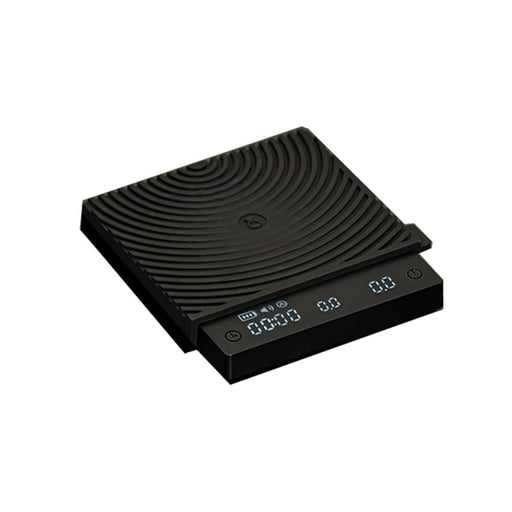
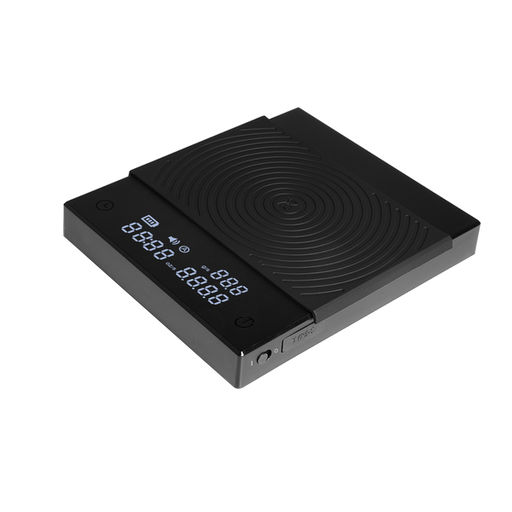
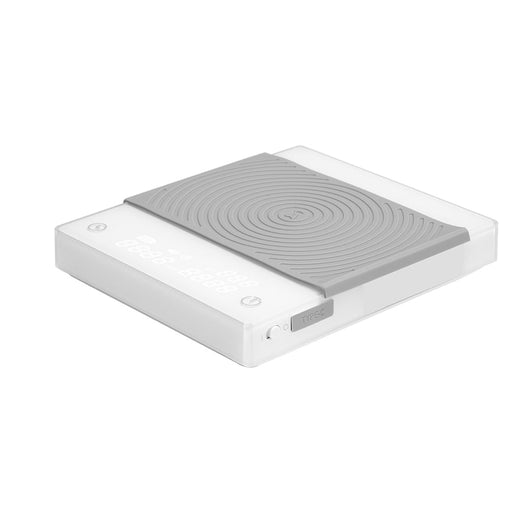
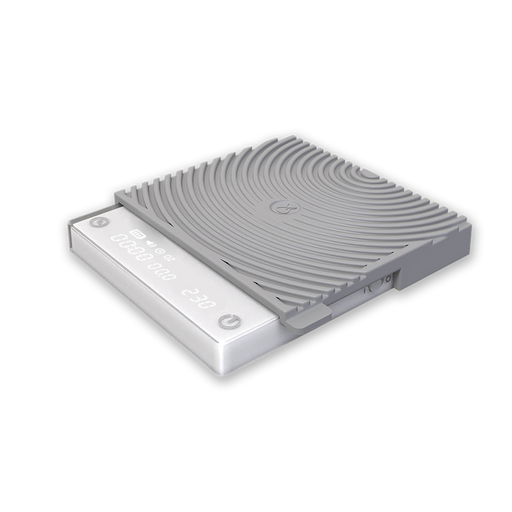
Timemore Black Mirror coffee scales
The Timemore Black Mirror series contains several different coffee scales for the home barista.
The models differ, among other things, on:
• Size
• Brewing modes
• Features
• Capacity
• Operation
A larger Black Mirror model can be suitable as an all-round coffee scale for pour over and other brewing methods.
A compact model can be more practical under an espresso machine.
Therefore, choose the specific Timemore scale according to your needs rather than just choosing the model with the most features.
Timemore or Acaia coffee scale?
Timemore and Acaia both make coffee scales for precise coffee brewing, but they do not necessarily cater to the same needs and budget.
Timemore Black Mirror is a strong choice for those who want features such as 0.1 gram resolution, a timer, and on selected models flow rate, without moving up into the highest price bracket.
Acaia Pearl is in a higher price range and is developed for users who want a more advanced coffee scale with, among other things, app connectivity and the possibility to work more detailed with brewing data.
This does not mean that you need an Acaia to brew good coffee.
For the vast majority of home brewers, a Timemore model can be plenty. Acaia becomes especially interesting if you know that you will use the extra features and wish to invest more in your coffee setup.
Therefore, choose based on brewing method and the features you will actually use rather than price alone.
Small or large coffee scale?
The size should fit your equipment.
Small coffee scale
A compact coffee scale is ideal for espresso.
It takes up less space on the drip tray and leaves more room for the cup.
It can also be practical for travel.
Large coffee scale
A larger platform is practical for V60, Chemex, and serving carafes.
It makes it easier to place larger brewing equipment stably on the scale.
If you brew both espresso and pour over, a medium-sized model can be a good compromise.
Can I use a regular kitchen scale?
Yes.
For example, for filter coffee and French press, a regular kitchen scale can be sufficient.
A dedicated coffee scale becomes especially interesting when you want:
• 0.1 gram resolution
• Faster response
• Built-in timer
• Compact size for espresso
• Brewing modes
• Flow rate
For espresso, the difference will often be much more noticeable than for a large carafe of filter coffee.
What should I choose as a beginner?
You do not need to start with the most expensive coffee scale.
For most people, a model with:
0.1 g resolution
timer
tare function
good response time
will be a very good starting point.
If you later begin to work more seriously with espresso or pour over, features like automatic timer and flow rate may become interesting.
Coffee scales for the home barista
A coffee scale is one of the tools that makes it easiest to work more systematically with coffee.
It doesn't tell you how the coffee should taste.
But it tells you exactly what you did.
If an espresso tastes good with:
18 g coffee
36 g espresso
28 seconds
you can repeat it.
If a V60 tastes good with:
15 g coffee
250 g water
2:50 minutes
you can repeat it.
It makes it much easier to learn from your brews and adjust one variable at a time.
Frequently asked questions about coffee scales
Which coffee scale should I choose?
It depends on the brewing method. For espresso, compact size, fast response time, and 0.1 gram resolution are important. For pour over, you should especially look for a timer, platform size, and maximum capacity.
How precise should a coffee scale be?
0.1 gram resolution is a good choice and especially useful for espresso. For large portions of filter coffee, extreme precision is less important.
Should a coffee scale have a timer?
It is not necessary, but very practical for espresso, V60, Chemex, and AeroPress.
What is the best coffee scale for espresso?
A compact and low scale with 0.1 gram resolution, fast response time, and timer is a good starting point.
What is the best coffee scale for V60?
Choose a coffee scale with a timer, clear display, and room for your V60 and serving carafe. Flow rate can be an extra feature if you want to work more detailed with your pouring technique.
What does TARE mean?
TARE resets the scale so that the weight of the cup, carafe, or coffee brewer is not counted.
Can I use a kitchen scale?
Yes. For standard filter coffee, many kitchen scales work fine. For espresso and manual pour over, a dedicated coffee scale offers more practical advantages.
Is an expensive coffee scale better?
Not necessarily. More expensive models may have faster response times and more features, but the best coffee scale is the one that fits your brewing method and your needs.


