
Skip to content

WDT – Weiss Distribution Technique

WDT tool for espresso – distribute the coffee before tamping

WDT stands for Weiss Distribution Technique and is a method for working with the ground coffee in the filter basket before it is tamped.

A WDT tool typically consists of several thin needles that are passed through the coffee to break up clumps and redistribute the ground coffee in the filter basket.

The goal is to create a better foundation for the subsequent tamping and espresso brewing.

At Brændeholm Risteri, you will find both traditional handheld WDT tools, rotating models, and automatic solutions from brands such as Subminimal, Motta, Barista Space, and Timemore.

See also our entire selection of espresso equipment.

What is WDT?

WDT is a technique where thin needles are moved through the ground coffee in the filter basket before tamping.

When coffee comes out of the grinder, it can lie unevenly in the portafilter and contain small clumps.

With WDT, you can work through the coffee bed and redistribute the coffee before it is compressed with the tamper.

WDT can therefore be a useful step in your puck preparation, but it is not a requirement for making good espresso.

It also does not replace:

  • A coffee grinder that can grind consistently for espresso

  • Correct dosing

  • A suitable filter basket

  • Tamping

  • A reasonable espresso recipe

View WDT as one tool among many that can help you work more systematically with espresso.

What does Weiss Distribution Technique mean?

Weiss Distribution Technique is the full name behind the abbreviation WDT.

In practice, the principle is simple:

Grind the coffee → distribute it with thin needles → tamp → brew espresso

It is, therefore, not a separate brewing method.

WDT is a step in the preparation of the coffee puck before the portafilter is inserted into the espresso machine.

Why use WDT?

WDT is particularly relevant if you find that the ground coffee:

  • Forms clumps

  • Lies very unevenly in the filter basket

  • Gathers more on one side

  • Is difficult to distribute before tamping

By working through the coffee bed, you can break up clumps and redistribute the coffee before tamping.

This can provide a more uniform foundation for brewing.

However, this does not mean that WDT automatically solves all espresso problems.

If the grind size, dose, or brew ratio is incorrect, a WDT tool cannot compensate for it.

What is channeling?

Channeling describes a phenomenon where water finds areas of less resistance through the coffee puck.

Instead of moving relatively evenly through the entire coffee bed, more water may pass through certain areas.

This can contribute to uneven extraction.

The distribution of the coffee before tamping is one of the factors that can affect the structure of the coffee puck.

WDT is therefore used, among other things, with the goal of creating a more uniform foundation before tamping.

However, it is important not to view WDT as a guarantee against channeling. Multiple parts of the espresso workflow affect the result.

How to use a WDT tool

A simple WDT routine can look like this:

1. Dose the ground coffee into the filter basket

The coffee can come directly from the grinder or be transferred from a dosing cup.

2. Optionally, place a dosing funnel on the portafilter

A dosing funnel helps keep the coffee in the basket while you work with the needles.

3. Pass the WDT needles through the coffee

Work calmly through the coffee bed and distribute the coffee throughout the basket.

4. Make the surface relatively level

Avoid leaving large piles on one side of the filter basket.

5. Remove the dosing funnel

If you have used a funnel, remove it.

6. Tamp the coffee

Use a tamper that fits your filter basket.

7. Brew the espresso

The portafilter is now ready for the espresso machine.

You do not need to spend a long time on WDT. The goal is a controlled and repeatable workflow.

Should the WDT needles go all the way into the coffee bed?

In traditional WDT, one usually works through a large part of the depth of the coffee bed rather than just scratching the surface.

The purpose is specifically to work with clumps and distribution throughout the coffee.

Move the needles in a controlled manner, and avoid unnecessarily hard movements against the bottom of the filter basket.

Toward the end, you can work more superficially to leave the coffee relatively evenly distributed before tamping.

How thick should the WDT needles be?

WDT tools typically use relatively thin needles.

Very thick needles move larger amounts of coffee at a time, while thinner needles can work more gently through the coffee bed.

This does not mean that one specific measurement is the only correct one.

The needles':

  • Thickness

  • Length

  • Quantity

  • Placement

  • Stiffness

all affect how the tool feels and works.

On products with replaceable needles, you can on some models choose between different thicknesses.

WDT together with a dosing funnel

A dosing funnel is one of the most practical accessories for manual WDT.

When the needles are moved through the ground coffee, some of the coffee might otherwise be pushed over the edge of the filter basket.

The funnel provides a higher edge around the portafilter.

The workflow then becomes:

Dosing funnel on → WDT → funnel off → tamping

The dosing funnel does not perform the distribution itself.

It simply helps keep the coffee in the filter basket while the WDT tool is working.

WDT or distributor?

A WDT tool and a classic distributor or leveler work differently.

WDT uses needles to work through the ground coffee.

A distributor or leveler typically works more with the top area or surface of the coffee bed.

This also means that you do not necessarily need both.

Many home baristas can keep puck preparation relatively simple:

WDT → tamping

If you are already getting good and stable results without a distributor, there is no reason to automatically add another step.

WDT or tamper?

They do not replace each other.

A WDT tool is used for distribution before tamping.

A tamper is used to compress the coffee puck afterward.

Therefore, a WDT model with a base or a rotating construction should not automatically be perceived as a traditional tamper.

When the WDT process is finished, the coffee is still tamped with a suitable espresso tamper, unless the manufacturer of a specific product indicates a different workflow.

Manual WDT or rotating WDT?

There are several ways to perform WDT.

Manual WDT

A traditional handheld WDT tool is moved through the coffee by hand.

The benefits are:

  • Simple construction

  • Full control over the movement

  • Can be used on different filter basket sizes

  • Relatively few mechanical parts

  • Easy to understand and use

Subminimal Flick and Motta Needle Distributor are examples of handheld WDT tools in our assortment.

Rotating WDT

A rotating model is placed on top of the filter basket, after which the needles move through the coffee in a fixed motion pattern.

This can make the workflow more reproducible and requires less manual control of every single needle movement.

On this type of tool, compatibility with the filter basket size becomes more important.

Automatic WDT

An automatic WDT uses a motor to move the needles.

Timemore AutoSpin is an example of this type.

Here, the tool is placed on a compatible portafilter, after which the needles are moved automatically through the coffee.

It is the most automated solution, but also significantly more expensive than a simple manual WDT tool.

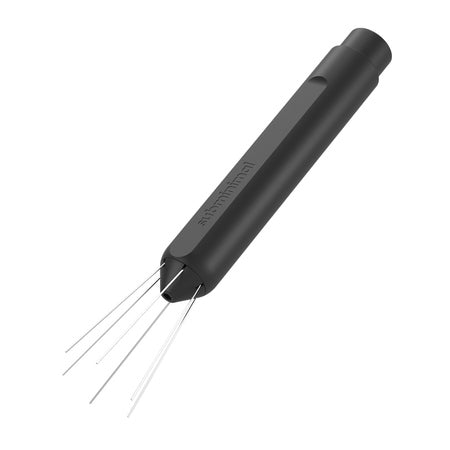
Subminimal Flick WDT Tool

Subminimal Flick WDT Tool is a handheld WDT tool with retractable needles.

With a push, the needles are extended, and after use, they can be retracted into the tool.

This makes storage especially convenient because the needles do not need to be left unprotected on the coffee station.

Flick also comes with the option of different needle thicknesses.

It is a good choice if you want:

  • Manual WDT

  • A compact tool

  • Retractable needles

  • Flexibility between different filter baskets

  • Simple storage

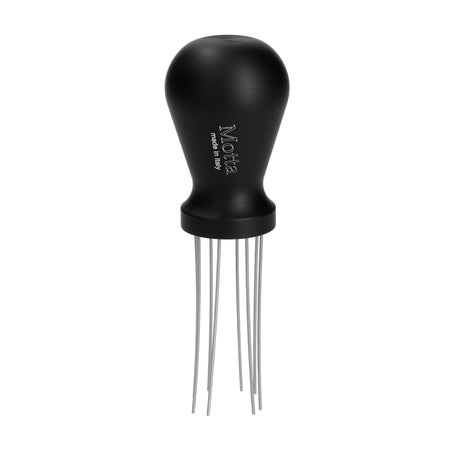
Motta WDT Tool

Motta Needle Distributor WDT Tool is a more traditional manual solution.

Here, you use the needles yourself to work through the ground coffee.

This makes the tool relevant if you want classic WDT without a motor or a base that must fit a specific diameter.

Manual WDT also gives you the opportunity to choose for yourself where in the coffee bed you want to work more or less.

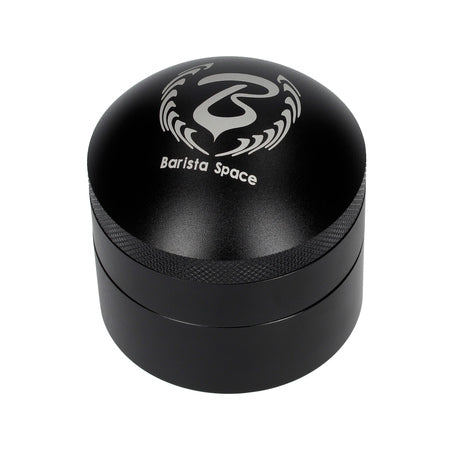
Barista Space C3 WDT

The Barista Space C3 model in our assortment works differently than a traditional handheld WDT tool.

The model is placed on a compatible 58 mm filter basket, after which it is turned so that the needles move through the coffee.

It should not be pressed down like a traditional tamper.

After distribution, the tool is removed, and the coffee is tamped with a standard tamper.

This type is relevant if you want a more controlled rotating WDT movement rather than guiding a handheld tool freely through the coffee.

Timemore AutoSpin WDT Tool

Timemore AutoSpin is an automatic WDT solution for 58 mm systems.

Instead of moving the needles manually, AutoSpin uses an electric motor to guide them through the coffee.

This makes the tool interesting if you want a more automated and reproducible puck preparation.

AutoSpin is especially relevant for those who:

  • Use a compatible 58 mm portafilter

  • Want automatic WDT

  • Make espresso often

  • Want to reduce the manual part of the distribution

  • Accept a higher price for more automation

For the home barista who just wants to try WDT, a simple manual tool is, however, significantly cheaper and can easily be sufficient.

Does WDT fit all portafilters?

It depends on the type.

A standard handheld WDT tool can usually be used on many different filter basket sizes because the tool does not need to rest precisely on the edge of the portafilter.

Rotating models with a fixed base, however, must fit the specific diameter.

This applies, for example, to models developed for 58 mm filter baskets.

Therefore, always check the compatibility on the specific product page.

WDT and precision baskets

WDT can also be used with precision baskets for espresso.

A precision basket does not change the basic principle:

The coffee is dosed, distributed, and tamped before brewing.

If you change the filter basket, however, you may find that the desired dose, grind setting, or espresso recipe needs to be adjusted.

WDT is only one step in this process.

WDT and the coffee grinder

A good coffee grinder is still far more important for espresso than a WDT tool.

WDT can help with the coffee the grinder delivers.

It cannot make a grinder with insufficient adjustment options suitable for espresso.

If you have to prioritize between a better espresso grinder and more puck preparation accessories, the coffee grinder should therefore normally come first.

Do I need WDT as a beginner?

No.

The most basic espresso setup is still:

  • Espresso machine

  • Coffee grinder suitable for espresso

  • Correct filter basket

  • Tamper

  • Coffee scale

  • Coffee beans

Once you have mastered the basic parts, WDT can be a simple next step.

It is especially relevant if you can see that the coffee comes out unevenly from the grinder or forms clumps in the filter basket.

You do not need to build a long puck preparation routine from the first day.

How long should you use WDT?

There is no specific time limit that fits everyone.

You just need to work long enough to break up obvious clumps and distribute the coffee through the filter basket.

Continuing for a long time does not automatically produce a better result.

The goal is a simple workflow you can repeat.

Can you use WDT too much?

More work is not necessarily better.

If you move the coffee violently or keep going for an unnecessarily long time, you might end up just moving the coffee around without a clear purpose.

Work calmly and systematically through the coffee bed.

When the clumps are broken up and the distribution looks reasonable, you can move on to tamping.

WDT and dosing

A stable coffee dose makes it easier to compare results from brew to brew.

Optionally use a coffee scale to weigh the desired amount of coffee.

If the dose is constantly changing, it becomes more difficult to assess whether a difference in the espresso is due to WDT, the grind size, or simply a different amount of coffee.

Controlled variables make espresso adjustment easier.

WDT and tamping

After WDT, the coffee bed should be tamped level.

You do not need to compensate with extra hard tamping pressure.

Use a tamper that fits the filter basket, and focus on a stable and level tamping.

WDT and tamping thus each have their own function:

WDT → distribution

Tamper → compression

Cleaning the WDT tool

Fine coffee particles can get stuck on the needles.

Therefore, wipe or brush the needles clean as needed.

At the same time, be careful because the thin needles can bend.

On models with:

  • Retractable needles

  • Replaceable needles

  • Motor

  • Battery

  • Magnetic base

you should follow the manufacturer's specific maintenance instructions.

An electric WDT tool should, of course, not be cleaned in the same way as a simple manual needle tool.

What do I do if a WDT needle bends?

On some models, the needles can be replaced.

If a needle becomes significantly bent, you should check the manufacturer's instructions and any spare parts.

Do not attempt to use unnecessary force against the filter basket during WDT.

Thin needles are precisely developed to move through the coffee and should be treated accordingly.

Which WDT tool should I choose?

Choose based on how simple or automated you want the workflow to be.

Subminimal Flick is interesting if you want manual WDT with retractable needles.

Motta WDT Tool is a simple choice for traditional manual WDT.

Barista Space C3 provides a rotating solution for a compatible 58 mm setup.

Timemore AutoSpin automates the needle movement itself and is particularly aimed at those who want a more reproducible and automated workflow.

None of them are necessary to make espresso.

Choose the model that fits your setup and the amount of work you want to perform yourself.

WDT tools at Brændeholm Risteri

At Brændeholm Risteri, you will find WDT tools for various espresso setups.

The assortment includes both:

  • Handheld WDT

  • WDT with retractable needles

  • Rotating WDT

  • Automatic WDT

  • Models for 58 mm systems

For the rest of your puck preparation, you can also see our selection of dosing funnels, tampers, precision baskets and coffee scales.

For the coffee itself, you will find our selection of coffee beans for espresso.

Frequently asked questions about WDT

What does WDT stand for?

WDT stands for Weiss Distribution Technique and is a method for working with the distribution of ground coffee in the filter basket before tamping.

What is a WDT tool used for?

The thin needles are used to break up clumps and redistribute the ground coffee before tamping.

Is WDT necessary for espresso?

No. You can make good espresso without WDT. It is an additional tool for puck preparation.

Should I use WDT before or after tamping?

Before. The coffee is distributed with WDT and then tamped.

Do I need to use a dosing funnel with WDT?

No, but a dosing funnel can make the work easier by keeping the coffee in the filter basket during WDT.

Are WDT and a distributor the same thing?

No. WDT uses needles to work through the coffee bed, while a classic distributor typically works more with the surface.

Can WDT prevent channeling?

WDT can help create a more uniform starting point for the coffee puck, but it is not a guarantee against channeling. Grind size, dosage, filter basket, tamping, and other factors also play a role.

What thickness of WDT needles should I choose?

Fine needles are common for WDT. However, the best solution also depends on the length and stiffness of the needles and the design of the tool.

Do all WDT tools fit 58 mm?

No. Handheld models are often less dependent on the diameter of the basket, while rotating models with a base must fit the filter basket.

Manual or automatic WDT?

Manual WDT is simple and inexpensive and provides full control. Automatic WDT reduces the manual effort and can provide a more reproducible routine, but it costs significantly more.

Subminimal Flick WDT Tool

Original price 289,00 kr - Original price 289,00 kr
Original price
289,00 kr
289,00 kr - 289,00 kr
Current price 289,00 kr

Subminimal Flick WDT Tool – Perfect your espresso like a baristaThe Subminimal Flick WDT Tool is created for coffee lovers who desire precision and...

View full details

Motta needle distributor WDT Tool

Original price 399,00 kr - Original price 399,00 kr
Original price
399,00 kr
399,00 kr - 399,00 kr
Current price 399,00 kr

Motta needle distributor WDT Tool The Motta Distribution Tool (WDT) will help you prepare the most delicious espresso, as it loosens and distribute...

View full details

Barista Space C3 WDT Base 58mm Black

Original price 449,00 kr - Original price 449,00 kr
Original price
449,00 kr
449,00 kr - 449,00 kr
Current price 449,00 kr

Barista Space C3 WDT with Base 58mm Black Improve your espresso shot! The Barista Space 58mm needle distributor is a tool that makes work easier an...

View full details

Timemore Autospin WDT Tool Silver

Original price 980,00 kr - Original price 980,00 kr
Original price
980,00 kr
980,00 kr - 980,00 kr
Current price 980,00 kr

The Timemore AutoSpin WDT Tool is an automatic WDT tool for those who want a more repeatable distribution of ground coffee before tamping. The Auto...

View full details

Timemore Autospin WDT Tool Black

Original price 980,00 kr - Original price 980,00 kr
Original price
980,00 kr
980,00 kr - 980,00 kr
Current price 980,00 kr

The Timemore AutoSpin WDT Tool is an automatic WDT tool for distributing ground coffee in the filter basket before tamping. The AutoSpin is placed ...

View full details

WDT tool for espresso – distribute the coffee before tamping

WDT stands for Weiss Distribution Technique and is a method for working with the ground coffee in the filter basket before it is tamped.

A WDT tool typically consists of several thin needles that are passed through the coffee to break up clumps and redistribute the ground coffee in the filter basket.

The goal is to create a better foundation for the subsequent tamping and espresso brewing.

At Brændeholm Risteri, you will find both traditional handheld WDT tools, rotating models, and automatic solutions from brands such as Subminimal, Motta, Barista Space, and Timemore.

See also our entire selection of espresso equipment.

What is WDT?

WDT is a technique where thin needles are moved through the ground coffee in the filter basket before tamping.

When coffee comes out of the grinder, it can lie unevenly in the portafilter and contain small clumps.

With WDT, you can work through the coffee bed and redistribute the coffee before it is compressed with the tamper.

WDT can therefore be a useful step in your puck preparation, but it is not a requirement for making good espresso.

It also does not replace:

  • A coffee grinder that can grind consistently for espresso

  • Correct dosing

  • A suitable filter basket

  • Tamping

  • A reasonable espresso recipe

View WDT as one tool among many that can help you work more systematically with espresso.

What does Weiss Distribution Technique mean?

Weiss Distribution Technique is the full name behind the abbreviation WDT.

In practice, the principle is simple:

Grind the coffee → distribute it with thin needles → tamp → brew espresso

It is, therefore, not a separate brewing method.

WDT is a step in the preparation of the coffee puck before the portafilter is inserted into the espresso machine.

Why use WDT?

WDT is particularly relevant if you find that the ground coffee:

  • Forms clumps

  • Lies very unevenly in the filter basket

  • Gathers more on one side

  • Is difficult to distribute before tamping

By working through the coffee bed, you can break up clumps and redistribute the coffee before tamping.

This can provide a more uniform foundation for brewing.

However, this does not mean that WDT automatically solves all espresso problems.

If the grind size, dose, or brew ratio is incorrect, a WDT tool cannot compensate for it.

What is channeling?

Channeling describes a phenomenon where water finds areas of less resistance through the coffee puck.

Instead of moving relatively evenly through the entire coffee bed, more water may pass through certain areas.

This can contribute to uneven extraction.

The distribution of the coffee before tamping is one of the factors that can affect the structure of the coffee puck.

WDT is therefore used, among other things, with the goal of creating a more uniform foundation before tamping.

However, it is important not to view WDT as a guarantee against channeling. Multiple parts of the espresso workflow affect the result.

How to use a WDT tool

A simple WDT routine can look like this:

1. Dose the ground coffee into the filter basket

The coffee can come directly from the grinder or be transferred from a dosing cup.

2. Optionally, place a dosing funnel on the portafilter

A dosing funnel helps keep the coffee in the basket while you work with the needles.

3. Pass the WDT needles through the coffee

Work calmly through the coffee bed and distribute the coffee throughout the basket.

4. Make the surface relatively level

Avoid leaving large piles on one side of the filter basket.

5. Remove the dosing funnel

If you have used a funnel, remove it.

6. Tamp the coffee

Use a tamper that fits your filter basket.

7. Brew the espresso

The portafilter is now ready for the espresso machine.

You do not need to spend a long time on WDT. The goal is a controlled and repeatable workflow.

Should the WDT needles go all the way into the coffee bed?

In traditional WDT, one usually works through a large part of the depth of the coffee bed rather than just scratching the surface.

The purpose is specifically to work with clumps and distribution throughout the coffee.

Move the needles in a controlled manner, and avoid unnecessarily hard movements against the bottom of the filter basket.

Toward the end, you can work more superficially to leave the coffee relatively evenly distributed before tamping.

How thick should the WDT needles be?

WDT tools typically use relatively thin needles.

Very thick needles move larger amounts of coffee at a time, while thinner needles can work more gently through the coffee bed.

This does not mean that one specific measurement is the only correct one.

The needles':

  • Thickness

  • Length

  • Quantity

  • Placement

  • Stiffness

all affect how the tool feels and works.

On products with replaceable needles, you can on some models choose between different thicknesses.

WDT together with a dosing funnel

A dosing funnel is one of the most practical accessories for manual WDT.

When the needles are moved through the ground coffee, some of the coffee might otherwise be pushed over the edge of the filter basket.

The funnel provides a higher edge around the portafilter.

The workflow then becomes:

Dosing funnel on → WDT → funnel off → tamping

The dosing funnel does not perform the distribution itself.

It simply helps keep the coffee in the filter basket while the WDT tool is working.

WDT or distributor?

A WDT tool and a classic distributor or leveler work differently.

WDT uses needles to work through the ground coffee.

A distributor or leveler typically works more with the top area or surface of the coffee bed.

This also means that you do not necessarily need both.

Many home baristas can keep puck preparation relatively simple:

WDT → tamping

If you are already getting good and stable results without a distributor, there is no reason to automatically add another step.

WDT or tamper?

They do not replace each other.

A WDT tool is used for distribution before tamping.

A tamper is used to compress the coffee puck afterward.

Therefore, a WDT model with a base or a rotating construction should not automatically be perceived as a traditional tamper.

When the WDT process is finished, the coffee is still tamped with a suitable espresso tamper, unless the manufacturer of a specific product indicates a different workflow.

Manual WDT or rotating WDT?

There are several ways to perform WDT.

Manual WDT

A traditional handheld WDT tool is moved through the coffee by hand.

The benefits are:

  • Simple construction

  • Full control over the movement

  • Can be used on different filter basket sizes

  • Relatively few mechanical parts

  • Easy to understand and use

Subminimal Flick and Motta Needle Distributor are examples of handheld WDT tools in our assortment.

Rotating WDT

A rotating model is placed on top of the filter basket, after which the needles move through the coffee in a fixed motion pattern.

This can make the workflow more reproducible and requires less manual control of every single needle movement.

On this type of tool, compatibility with the filter basket size becomes more important.

Automatic WDT

An automatic WDT uses a motor to move the needles.

Timemore AutoSpin is an example of this type.

Here, the tool is placed on a compatible portafilter, after which the needles are moved automatically through the coffee.

It is the most automated solution, but also significantly more expensive than a simple manual WDT tool.

Subminimal Flick WDT Tool

Subminimal Flick WDT Tool is a handheld WDT tool with retractable needles.

With a push, the needles are extended, and after use, they can be retracted into the tool.

This makes storage especially convenient because the needles do not need to be left unprotected on the coffee station.

Flick also comes with the option of different needle thicknesses.

It is a good choice if you want:

  • Manual WDT

  • A compact tool

  • Retractable needles

  • Flexibility between different filter baskets

  • Simple storage

Motta WDT Tool

Motta Needle Distributor WDT Tool is a more traditional manual solution.

Here, you use the needles yourself to work through the ground coffee.

This makes the tool relevant if you want classic WDT without a motor or a base that must fit a specific diameter.

Manual WDT also gives you the opportunity to choose for yourself where in the coffee bed you want to work more or less.

Barista Space C3 WDT

The Barista Space C3 model in our assortment works differently than a traditional handheld WDT tool.

The model is placed on a compatible 58 mm filter basket, after which it is turned so that the needles move through the coffee.

It should not be pressed down like a traditional tamper.

After distribution, the tool is removed, and the coffee is tamped with a standard tamper.

This type is relevant if you want a more controlled rotating WDT movement rather than guiding a handheld tool freely through the coffee.

Timemore AutoSpin WDT Tool

Timemore AutoSpin is an automatic WDT solution for 58 mm systems.

Instead of moving the needles manually, AutoSpin uses an electric motor to guide them through the coffee.

This makes the tool interesting if you want a more automated and reproducible puck preparation.

AutoSpin is especially relevant for those who:

  • Use a compatible 58 mm portafilter

  • Want automatic WDT

  • Make espresso often

  • Want to reduce the manual part of the distribution

  • Accept a higher price for more automation

For the home barista who just wants to try WDT, a simple manual tool is, however, significantly cheaper and can easily be sufficient.

Does WDT fit all portafilters?

It depends on the type.

A standard handheld WDT tool can usually be used on many different filter basket sizes because the tool does not need to rest precisely on the edge of the portafilter.

Rotating models with a fixed base, however, must fit the specific diameter.

This applies, for example, to models developed for 58 mm filter baskets.

Therefore, always check the compatibility on the specific product page.

WDT and precision baskets

WDT can also be used with precision baskets for espresso.

A precision basket does not change the basic principle:

The coffee is dosed, distributed, and tamped before brewing.

If you change the filter basket, however, you may find that the desired dose, grind setting, or espresso recipe needs to be adjusted.

WDT is only one step in this process.

WDT and the coffee grinder

A good coffee grinder is still far more important for espresso than a WDT tool.

WDT can help with the coffee the grinder delivers.

It cannot make a grinder with insufficient adjustment options suitable for espresso.

If you have to prioritize between a better espresso grinder and more puck preparation accessories, the coffee grinder should therefore normally come first.

Do I need WDT as a beginner?

No.

The most basic espresso setup is still:

  • Espresso machine

  • Coffee grinder suitable for espresso

  • Correct filter basket

  • Tamper

  • Coffee scale

  • Coffee beans

Once you have mastered the basic parts, WDT can be a simple next step.

It is especially relevant if you can see that the coffee comes out unevenly from the grinder or forms clumps in the filter basket.

You do not need to build a long puck preparation routine from the first day.

How long should you use WDT?

There is no specific time limit that fits everyone.

You just need to work long enough to break up obvious clumps and distribute the coffee through the filter basket.

Continuing for a long time does not automatically produce a better result.

The goal is a simple workflow you can repeat.

Can you use WDT too much?

More work is not necessarily better.

If you move the coffee violently or keep going for an unnecessarily long time, you might end up just moving the coffee around without a clear purpose.

Work calmly and systematically through the coffee bed.

When the clumps are broken up and the distribution looks reasonable, you can move on to tamping.

WDT and dosing

A stable coffee dose makes it easier to compare results from brew to brew.

Optionally use a coffee scale to weigh the desired amount of coffee.

If the dose is constantly changing, it becomes more difficult to assess whether a difference in the espresso is due to WDT, the grind size, or simply a different amount of coffee.

Controlled variables make espresso adjustment easier.

WDT and tamping

After WDT, the coffee bed should be tamped level.

You do not need to compensate with extra hard tamping pressure.

Use a tamper that fits the filter basket, and focus on a stable and level tamping.

WDT and tamping thus each have their own function:

WDT → distribution

Tamper → compression

Cleaning the WDT tool

Fine coffee particles can get stuck on the needles.

Therefore, wipe or brush the needles clean as needed.

At the same time, be careful because the thin needles can bend.

On models with:

  • Retractable needles

  • Replaceable needles

  • Motor

  • Battery

  • Magnetic base

you should follow the manufacturer's specific maintenance instructions.

An electric WDT tool should, of course, not be cleaned in the same way as a simple manual needle tool.

What do I do if a WDT needle bends?

On some models, the needles can be replaced.

If a needle becomes significantly bent, you should check the manufacturer's instructions and any spare parts.

Do not attempt to use unnecessary force against the filter basket during WDT.

Thin needles are precisely developed to move through the coffee and should be treated accordingly.

Which WDT tool should I choose?

Choose based on how simple or automated you want the workflow to be.

Subminimal Flick is interesting if you want manual WDT with retractable needles.

Motta WDT Tool is a simple choice for traditional manual WDT.

Barista Space C3 provides a rotating solution for a compatible 58 mm setup.

Timemore AutoSpin automates the needle movement itself and is particularly aimed at those who want a more reproducible and automated workflow.

None of them are necessary to make espresso.

Choose the model that fits your setup and the amount of work you want to perform yourself.

WDT tools at Brændeholm Risteri

At Brændeholm Risteri, you will find WDT tools for various espresso setups.

The assortment includes both:

  • Handheld WDT

  • WDT with retractable needles

  • Rotating WDT

  • Automatic WDT

  • Models for 58 mm systems

For the rest of your puck preparation, you can also see our selection of dosing funnels, tampers, precision baskets and coffee scales.

For the coffee itself, you will find our selection of coffee beans for espresso.

Frequently asked questions about WDT

What does WDT stand for?

WDT stands for Weiss Distribution Technique and is a method for working with the distribution of ground coffee in the filter basket before tamping.

What is a WDT tool used for?

The thin needles are used to break up clumps and redistribute the ground coffee before tamping.

Is WDT necessary for espresso?

No. You can make good espresso without WDT. It is an additional tool for puck preparation.

Should I use WDT before or after tamping?

Before. The coffee is distributed with WDT and then tamped.

Do I need to use a dosing funnel with WDT?

No, but a dosing funnel can make the work easier by keeping the coffee in the filter basket during WDT.

Are WDT and a distributor the same thing?

No. WDT uses needles to work through the coffee bed, while a classic distributor typically works more with the surface.

Can WDT prevent channeling?

WDT can help create a more uniform starting point for the coffee puck, but it is not a guarantee against channeling. Grind size, dosage, filter basket, tamping, and other factors also play a role.

What thickness of WDT needles should I choose?

Fine needles are common for WDT. However, the best solution also depends on the length and stiffness of the needles and the design of the tool.

Do all WDT tools fit 58 mm?

No. Handheld models are often less dependent on the diameter of the basket, while rotating models with a base must fit the filter basket.

Manual or automatic WDT?

Manual WDT is simple and inexpensive and provides full control. Automatic WDT reduces the manual effort and can provide a more reproducible routine, but it costs significantly more.