



Electric coffee grinder for espresso, filter coffee, and freshly ground coffee
An electric coffee grinder makes it quick and easy to grind whole coffee beans immediately before brewing.
This can make a huge difference to the coffee experience, because coffee begins to change faster once the beans are ground.
However, the right coffee grinder depends to a large extent on how you brew.
A grinder for espresso must be able to make very small and precise adjustments to the grind size, while a coffee grinder for V60, Chemex, and filter coffee has different requirements.
At Brændeholm Risteri, you will find electric coffee grinders for both espresso, filter coffee, and the home barista, including models from, among others, Eureka, Fellow, Sage, and Varia.
Why choose an electric coffee grinder?
The biggest advantage is convenience.
Instead of grinding coffee beans manually, you turn a setting, press a button, or activate the grinder and get the desired amount of coffee in a short time.
This is especially practical if you:
• Brew coffee every day
• Make several cups at a time
• Use an espresso machine
• Frequently switch between different brewing methods
• Want to make coffee brewing faster
However, an electric coffee grinder is not automatically better than a manual coffee grinder.
A good manual grinder can deliver very high quality.
The electric grinder's great advantage is mainly speed, capacity, and workflow.
Why grind coffee beans just before brewing?
Whole coffee beans protect a large part of the coffee's aromatic compounds inside the bean itself.
When coffee is ground, the surface area increases significantly.
This means that the ground coffee is affected more quickly by, for example, air.
Therefore, it makes good sense to:
store the coffee as whole beans
and
grind the amount you need immediately before brewing.
At the same time, a coffee grinder makes it possible to adjust the grind size to the brewing method you are using.
Burrs or blades?
There are basically two very different types of electric coffee grinders.
Coffee grinder with burrs
A burr grinder uses two grinding surfaces that the coffee beans pass between.
The distance between the burrs largely determines the grind size.
This makes it possible to work systematically with:
espresso
filter coffee
V60
AeroPress
French press
and other brewing methods.
Coffee grinder with rotating blade
A cheap blade grinder functions more like a small blender.
The blade chops the coffee beans, and the grind size is controlled mainly by how long the machine runs.
This provides less direct control over particle size.
If you would like to take coffee brewing seriously, we therefore recommend a coffee grinder with actual burrs rather than a blade grinder.
Electric coffee grinder for espresso
Espresso places particularly high demands on the coffee grinder.
This is because small changes in grind size can change how fast the water runs through the coffee puck.
If the coffee is ground just slightly finer or coarser, the brew time can change significantly.
A good espresso grinder should therefore primarily have:
• Fine adjustment of the grind size
• Stable grinding mechanism
• Possibility for small adjustments
• Consistent dosing or easy single dosing
• An operating range that is fine enough for espresso
It is not the number of settings alone that determines how good the grinder is.
The crucial factor is how finely you can adjust within the espresso range.
How finely should coffee be ground for espresso?
Espresso is ground finely.
However, there is no single specific setting that suits all coffee beans or espresso machines.
As a starting point:
If the espresso runs too fast, the coffee is ground finer.
If the espresso runs too slow, the coffee is ground coarser.
A common starting point could, for example, be:
18 g of coffee in
36 g of espresso out
in approximately
25–35 seconds
Then the grinder is adjusted according to the taste and the flow.
That is precisely why the grinder is so important for espresso.
Why is the coffee grinder so important for espresso?
It is easy to focus almost exclusively on the espresso machine.
But an expensive espresso machine cannot compensate for a grinder that cannot deliver the necessary grind size or precision.
If the grinder jumps too much between settings, you can end up with:
one setting where the espresso runs too fast
and
the next where it almost doesn't run at all.
A dedicated espresso grinder allows for much smaller adjustments.
If espresso is your primary brewing method, we would therefore prioritize a good coffee grinder very highly.
Electric coffee grinder for filter coffee
For filter coffee, the requirements are different.
Here you normally work with a coarser grind size than for espresso.
A filter grinder should ideally provide good control in the areas around:
• V60
• Chemex
• Automatic filter coffee
• Clever Dripper
• AeroPress
• French press
If you only brew filter coffee, you don't necessarily have to pay extra for a grinder that can make extremely small espresso adjustments.
Instead, you can prioritize a grinder that performs very well in the range you actually use.
Electric coffee grinder for V60
For Hario V60, one typically uses a medium to medium-fine grind size.
The exact setting depends, among other things, on:
• Coffee quantity
• The coffee bean
• Roast degree
• Pouring technique
• Desired brew time
If the water runs extremely quickly through the coffee bed, you can try a finer grind.
If the flow becomes very slow, you can try coarser.
An electric coffee grinder makes it easy to repeat the same setting and then make small adjustments between brews.
Electric coffee grinder for Chemex
Chemex typically uses a slightly coarser grind size than V60.
The heavy paper filter and larger brews mean that very fine coffee can result in a very slow flow.
A good starting point is therefore medium-coarse grind.
If you often brew both Chemex and espresso, you should choose a coffee grinder with a sufficiently large working range for both.
Alternatively, two specialized grinders can be more practical for the very committed home barista.
Electric coffee grinder for AeroPress
AeroPress is very flexible.
You can use anything from a relatively fine to a coarser grind depending on the recipe.
An electric all-round coffee grinder therefore works very well for AeroPress.
For our simple AeroPress recipe, a medium-fine grind is a good starting point.
After that, you can adjust:
finer for more extraction
or
coarser for less extraction.
Electric coffee grinder for French press
For French press, a medium-coarse to coarse grind is normally used.
If the coffee is ground very finely, you can get more sediment in the cup, and the flow through the plunger's metal filter can become more difficult.
If you primarily use a French press, you don't need a specialized espresso grinder.
A good electric filter grinder with a stable coarse working range is usually more relevant.
Espresso or filter grinder?
This is one of the most important questions when you choose a coffee grinder.
Primarily espresso
Choose a grinder with very fine adjustment and an operating range developed for espresso.
Primarily filter coffee
Prioritize good performance at medium and coarser grind sizes.
Both espresso and filter coffee
Choose an all-round grinder that is developed for both areas.
But be aware that there are often compromises.
A coffee grinder that is fantastic for espresso is not automatically the best filter grinder – and vice versa.
What is a single dose coffee grinder?
A single dose coffee grinder is designed so that you weigh the desired amount of coffee beans before grinding.
Example:
You weigh 18 grams of coffee beans.
You pour the 18 grams into the grinder.
You grind them.
After that, the grinder is basically ready for the next portion.
This is in contrast to a traditional grinder with a large bean hopper, where coffee beans can remain in the hopper.
Single dosing has become popular among coffee enthusiasts because it makes it easy to:
• Switch between different coffees
• Weigh each dose precisely
• Work with espresso recipes
• Keep track of coffee in and coffee out
Varia VS3 and Eureka Mignon Zero are examples of grinders that are built around the single dose workflow.
Single dose or bean hopper?
It depends on your routine.
Single dose
Good if you:
switch frequently between coffee beans
weigh each portion
experiment a lot
or want precise control.
Bean hopper
Good if you:
use the same coffee every day
want quick operation
and do not want to weigh beans before every cup.
Sage Smart Grinder Pro, for example, is built more around the traditional hopper and dosing workflow, while several espresso-oriented models focus on single dosing.
One solution is not automatically better than the other.
What does retention mean?
Retention is coffee that remains inside the coffee grinder after grinding.
If you put 18.0 grams of coffee beans into the grinder and get 17.5 grams of ground coffee out, some of the difference has remained in the grinder.
Some may come out during the next grinding.
Low retention is particularly interesting for single dosing, because you typically want almost the entire weighed dose to come out again.
Retention can also be relevant if you often switch between different coffee beans.
What does zero retention mean?
The term “zero retention” is often used in the marketing of coffee grinders.
It should not necessarily be understood as a promise that there literally will never be a single coffee particle left in the grinder.
In practice, it is about designs that try to minimize retention.
It is more useful to compare the grinder's workflow and actual retention than to focus solely on the product name.
What is stepless adjustment?
A stepless coffee grinder does not have fixed clicks between grind sizes.
Instead, you can move the adjustment continuously.
This is particularly useful for espresso, because you can make very small changes.
If an espresso, for example, runs a little bit too fast, you can move the grinder slightly finer.
You are not limited to the next fixed click.
Many dedicated espresso grinders therefore use stepless or very finely stepped adjustment.
Stepped or stepless coffee grinder?
Stepped
Has fixed steps.
The advantage is that it is easy to:
• Remember a setting
• Switch between brewing methods
• Go back to the same position
Stepless
Has continuous adjustment.
The advantage is:
• Very small changes
• Great control for espresso
If you primarily brew filter coffee, stepped is often perfectly fine.
For espresso, stepless can be a big advantage.
Conical or flat burrs?
Electric coffee grinders often use either:
conical burrs
or
flat burrs.
Both types can be used in coffee grinders of very high quality.
It is therefore too simple to say that flat burrs are always better than conical – or vice versa.
The result also depends on:
• Burr geometry
• Diameter
• Motor
• Speed
• Alignment
• Adjustment system
• The grinder's other construction
You should therefore not choose a coffee grinder solely based on whether the burrs are flat or conical.
Instead, look at what the whole grinder is developed for.
Are larger burrs better?
Larger burrs can have advantages in terms of capacity and workflow, but size alone does not determine the quality.
A well-constructed grinder with smaller burrs can easily deliver very good results.
When you compare coffee grinders, it is more relevant to look at:
brewing method
adjustment options
workflow
retention
speed
and the quality of the entire grinding system.
A large number in millimeters is not in itself a guarantee of better coffee.
Fellow Opus
Fellow Opus is developed as a versatile electric coffee grinder.
It is interesting for you if you want to use the same grinder for multiple brewing methods.
This makes it relevant for, for example:
• Espresso
• AeroPress
• V60
• Filter coffee
• Chemex
• French press
An all-round grinder is especially practical if you do not want a separate grinder for espresso and filter.
If espresso is your absolute main focus, a more specialized espresso grinder can, however, provide a different workflow and fine adjustment.
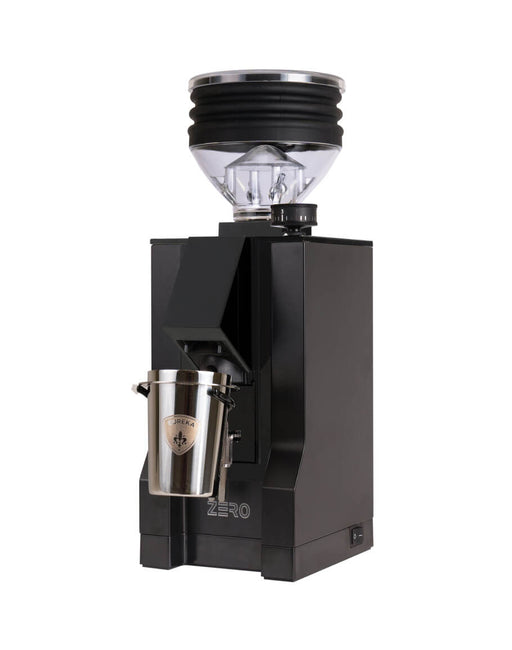
Eureka Mignon Zero
Eureka Mignon Zero is a single dose-oriented coffee grinder.
It is particularly interesting for the home barista who works systematically with:
weighing
espresso
small adjustments
and switching between coffee beans.
Instead of having a large amount of coffee sitting in the hopper, you can weigh the desired portion and grind it directly.
This fits well with modern espresso recipes, where both input and output are weighed.
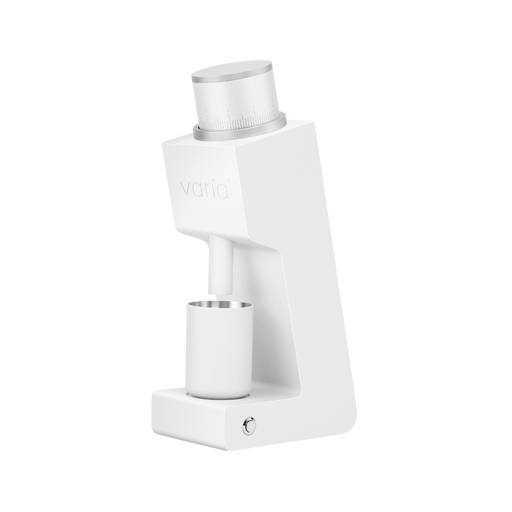
Varia VS3
Varia VS3 Gen 2 is also built around single dosing.
The compact design and fine adjustment make it particularly interesting for coffee enthusiasts who want to work precisely with the grind size.
It can be used for different brewing methods, but is especially interesting if espresso plays a large role in your coffee setup.
As with all coffee grinders, the choice should, however, be based on your own brewing routine rather than design or specifications alone.
Sage Smart Grinder Pro
Sage Smart Grinder Pro uses a more traditional workflow with a bean hopper and electronic dosing.
This makes it interesting if you want to be able to have coffee beans in the grinder and dose directly to:
• Portafilter
• Filter
• Container
It covers a wide grind range and is therefore obvious for home users who want one user-friendly electric coffee grinder for different brewing methods.
If, on the other hand, you want to work specifically with single dosing and very fine espresso adjustment, a more espresso-oriented grinder may be more relevant.
Should you have a special grinder for a Sage espresso machine?
No.
You do not need to use a Sage coffee grinder with a Sage espresso machine.
A separate espresso grinder from, for example, Eureka, Varia, Fellow, or another manufacturer can easily be used.
The crucial factor is that the grinder:
can grind finely enough
can be adjusted precisely
and fits your workflow.
If you, for example, have a Sage Bambino or Bambino Plus, a good separate espresso grinder can be an important part of the setup.
What should I prioritize for espresso?
If you primarily make espresso, we would prioritize in this order:
Adjustment options
The grinder must be able to be fine-tuned precisely.
Grind quality
It must be stable and consistent.
Workflow
Single dose or hopper according to your preference.
Retention
Particularly relevant for single dosing.
Size and noise
Important in daily use, but less decisive for the espresso itself.
Features like a display and timer can be practical, but they cannot compensate for a lack of precision in the grinder.
What should I prioritize for filter coffee?
For filter, I would especially look at:
A good medium/coarse operating range
Easy change between settings
Consistent grinding
Practical collection of the ground coffee
Low static electricity and minimal mess
If you switch frequently between V60, Chemex, and French press, a clear and reproducible adjustment is also very practical.
Should I buy one grinder for both espresso and filter?
For most home users, one good all-round grinder can be the most practical solution.
But there is a reason why many coffee enthusiasts end up with two.
Espresso requires very small adjustments.
Filter coffee requires a much coarser operating range.
If you switch from espresso to French press in the morning and back to espresso later, you have to move the grinder through a large range and then find your old espresso setting again.
This is doable on a good all-around grinder.
But if you brew both very often, separate grinders might be more practical.
Electric or manual coffee grinder?
Both have their advantages.
Electric coffee grinder
Advantages:
• Fast
• Convenient
• Good for many servings
• Suitable for daily espresso
• Minimal physical effort
Manual coffee grinder
Advantages:
• Compact
• No electricity needed
• Easy to take with you
• Many good models provide high grinding quality for the money
• Typically quieter
If you only brew one V60 a day, a manual coffee grinder might be plenty.
If you make several espressos every morning, an electric grinder quickly becomes very attractive.
Is a more expensive coffee grinder worth the money?
To a certain point, a better coffee grinder can make a noticeable difference.
This applies especially to espresso.
A more expensive grinder can, among other things, offer:
• More precise adjustment
• Better workflow
• Lower retention
• More robust construction
• Better motor
• More specialized grinding geometry
However, price and coffee quality do not necessarily follow each other one-to-one.
You should buy the grinder that fits your needs.
An expensive dedicated espresso grinder doesn't necessarily make sense if you exclusively brew French press coffee.
Coffee grinder with timer
Some electric coffee grinders can dose by time.
For example, you set the grinder to run for a specific number of seconds.
When the coffee beans and the grind setting are relatively stable, this can provide a convenient and repeatable dose.
However, there will still be some variation.
If very precise dosing is important – especially for espresso – we recommend checking the quantity on a coffee scale.
Coffee grinder with scale
Some coffee grinders can dose by weight rather than time.
This can make the workflow more precise and automatic.
However, it is not necessary for making good coffee.
You can also:
weigh the coffee beans separately
grind them
and then weigh the ground coffee as needed.
A separate coffee scale also makes it possible to measure the espresso itself or the brewing water.
How much coffee should you grind?
Preferably only grind the amount of coffee you need.
Examples:
Espresso: about 18 g as a standard starting point for a double espresso.
V60: 15 g of coffee to 250 g of water.
Filter coffee: approximately 60 g of coffee per liter of water.
Chemex: about 30 g of coffee to 500 g of water.
French press: about 60 g of coffee per liter of water.
The numbers are starting points, not hard rules.
Why does ground espresso clump?
Very finely ground coffee can form small clumps.
This is normal and can be influenced by, among other things:
• The coffee beans
• Humidity
• Static electricity
• The grinder's construction
• The grind size
For espresso, many home baristas therefore use a WDT tool to distribute the ground coffee in the filter basket.
The goal is to create an even bed of coffee before tamping.
Why is there coffee everywhere around the grinder?
Static electricity can cause very fine coffee particles to stick to the grinder, the container, and the workbench.
Some grinders handle this better than others.
Also, keep the coffee grinder and the area around the chute clean.
If the manufacturer allows it, there are various techniques to reduce static electricity, but always follow the instructions for your specific grinder.
How do you clean an electric coffee grinder?
The coffee grinder should be cleaned regularly.
Coffee leaves both particles and oils in the grinder.
How often cleaning is necessary depends on:
• How much coffee you grind
• The roast level
• The grinder's construction
• The specific coffee grinder
Always start with the manufacturer's instructions.
Typically, you can:
empty the grinder of coffee beans
brush away loose coffee residues
clean the bean hopper and collection container
and follow the manufacturer's directions to access the grinding chamber.
Some grinders can be cleaned with products such as Urnex Grindz.
However, never use water directly on the burrs, motor, or electronics unless the manufacturer specifically states it.
Can you wash the burrs?
Normally, metal burrs should not be rinsed under water.
Moisture can, among other things, cause problems with corrosion and coffee that later sticks to the mechanism.
Instead, use a brush or the cleaning method the manufacturer recommends.
Removable plastic containers can often be washed separately, but always check the manual.
When should the burrs be changed?
Burrs generally last a long time with normal home use.
There is no single specific number of years that applies to everyone.
The wear depends on, among other things:
• The material
• The burr size
• How much coffee is ground
• The hardness of the coffee
• If foreign objects get into the grinder
If, after very long use, the grinder starts to grind significantly slower or gives poorer results despite cleaning and correct adjustment, burr wear might be something to investigate.
For most home users, however, this is not something you need to worry about when buying.
Can you use dark roasted coffee beans in an electric coffee grinder?
Yes.
But very dark roasted coffee beans may have more visible oil on the surface.
This can result in more oil deposits in:
• The bean hopper
• The grinding chamber
• The chute
If you use very dark and oily coffee, it may therefore be necessary to clean the grinder more often.
Also follow the manufacturer's recommendations, especially if the grinder is part of a fully automatic coffee machine.
Which electric coffee grinder should I choose?
First, base your choice on your brewing method.
I only make espresso
Choose a dedicated espresso grinder with precise adjustment.
I mostly make V60 and filter coffee
Choose a grinder with good settings in the filter range.
I make both espresso and filter
Choose a versatile grinder with a large operating range.
I change coffee beans all the time
Consider single dose.
I always use the same coffee
A traditional hopper can provide a very convenient workflow.
I want the least amount of work possible
Choose an electric model with a simple dosing solution.
There is no one electric coffee grinder that is best for everyone.
The right grinder is the one that fits the way you actually make coffee.
Frequently asked questions about electric coffee grinders
Which electric coffee grinder is best?
It depends on the brewing method. For espresso, precise fine-tuning should be prioritized, while a filter grinder must work well at medium and coarser grind sizes.
What is the difference between an espresso grinder and a regular coffee grinder?
An espresso grinder can grind very finely and allows for small adjustments within the espresso range. A regular filter grinder does not need the same degree of fine-tuning.
Can the same coffee grinder be used for espresso and filter coffee?
Yes, if the grinder has a sufficiently large operating range. If you switch very often, however, two specialized grinders might be more practical.
Is a burr coffee grinder better than a blade grinder?
For controlled coffee brewing, burrs are normally recommended because the grind size can be set mechanically through the distance between the grinding surfaces.
What is a single dose coffee grinder?
It is a grinder intended for you to weigh the coffee beans for each individual brew instead of having a large amount of coffee sitting in the hopper.
What does stepless coffee grinder mean?
Stepless means that the grind size can be adjusted continuously without fixed clicks. This allows for very small changes and is particularly useful for espresso.
Should I choose flat or conical burrs?
Both types can yield excellent results. Burr geometry, construction, and the grinder's overall design matter more than the shape alone.
How finely should coffee be ground for espresso?
Espresso requires a fine grind. If the espresso runs too fast, grind finer. If it runs too slowly, grind coarser.
Can an electric coffee grinder be used for French press?
Yes, if it can grind coarsely enough.
How often should an electric coffee grinder be cleaned?
It depends on usage and coffee beans. Remove loose coffee residues regularly and follow the manufacturer's recommendations for more thorough cleaning.
Is an expensive coffee grinder more important than an expensive espresso machine?
Both matter, but the grinder has a very significant impact on espresso. A machine cannot compensate for a grinder that cannot be adjusted precisely enough.


