What does coffee processing mean?
Coffee processing – also referred to as coffee processing or post-harvest processing – describes the work performed on the coffee cherry after harvest, leading up to the dried green coffee bean, which can then be transported and roasted.
The coffee bean is essentially the seed inside the coffee fruit. Once the coffee cherries have been harvested, the seeds must be extracted from the fruit, dried to a stable level, and prepared for storage and export.
How this is done can have a significant impact on the character of the coffee in the cup.
Three of the most well-known processing methods are:
- Washed – washed process
- Natural – dry process
- Honey – honey process
There are also other, more experimental methods, but the three above are a good starting point for understanding what the labels on a bag of coffee mean.
If you first want to understand the raw material itself, you can read more about what coffee beans are.
From coffee cherry to green coffee bean
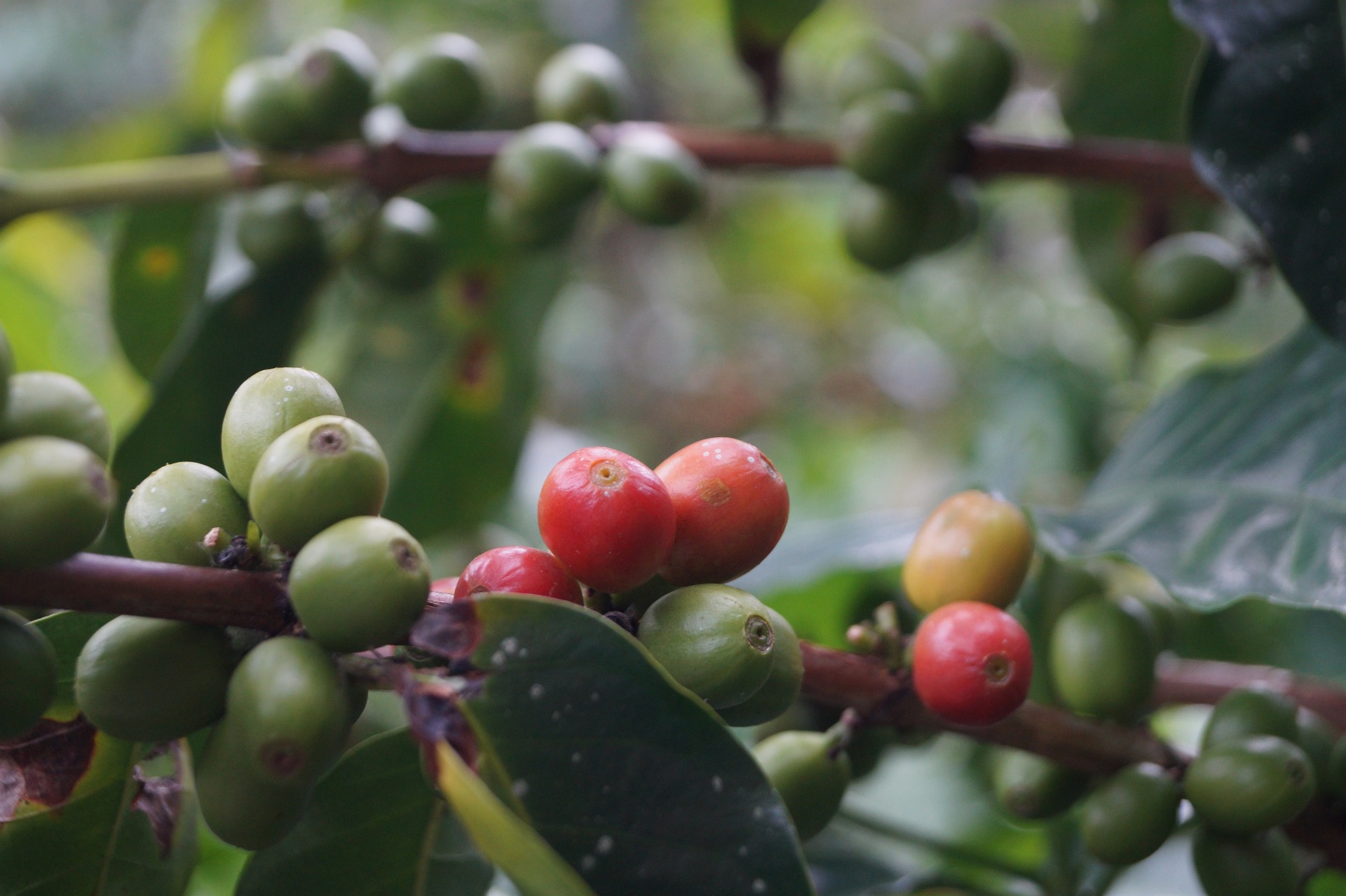
Coffee grows as fruit on the coffee plant.
Inside the coffee cherry, there are usually two seeds, which are what we later call coffee beans.
Around the seeds are several layers, including:
- Outer skin
- Pulp
- A sticky layer called mucilage
- The parchment layer
- The silverskin
- The coffee seed itself
After harvesting, several of these layers must be removed before the coffee beans are ready for storage and subsequent export.
The difference between, for example, washed, natural, and honey-processed coffee is largely about when the various parts of the coffee fruit are removed, and how the coffee ferments and dries during the process.
Why does processing affect the taste?
Processing is one of several factors that shape the finished coffee.
The taste of the coffee is also influenced by, among other things:
- Coffee variety
- Origin
- Altitude
- Climate
- Maturity at harvest
- Fermentation
- Drying
- Storage
- Roasting
- Brewing method
It is therefore important not to regard the processing method as a guarantee of a specific taste.
A natural coffee will not necessarily taste the same as another natural coffee, and two washed coffees can likewise be very different.
However, processing can significantly affect the sensory expression of the coffee and is therefore important information when trying to understand a coffee.
What is washed coffee?
With washed coffee, also called washed or wet-processed coffee, the coffee cherry's skin and the majority of the pulp are removed relatively early in the process.
After depulping, a sticky mucilage layer remains around the parchment.
This layer must be removed before the coffee beans are dried.
Traditionally, this often happens through fermentation followed by washing, but the exact method varies between producers and facilities. Mucilage can also be removed mechanically.
Once the mucilage is removed, the coffee beans are dried while still protected by the parchment layer.
The parchment is removed later, before the coffee is sorted and prepared for export.
How does the washed process work?
A simplified sequence can look like this:
- Ripe coffee cherries are harvested.
- The cherries are sorted.
- The skin and a large part of the pulp are removed in a depulper.
- The remaining mucilage layer is removed through fermentation, mechanical processing, or a combination.
- The coffee beans are washed as needed.
- The coffee is dried in parchment.
- After drying and resting, the parchment layer is removed.
- The green coffee beans are sorted and prepared for further trade.
The actual process can vary significantly from producer to producer.
Therefore, there is not one single washed process that all coffee producers follow in exactly the same way.
How does washed coffee taste?
Washed coffees are often associated with a clean and distinct cup, where the coffee's acidity, structure, and origin character can emerge clearly.
Among other things, you might experience washed coffees as:
- Clean
- Clear
- Lively
- Fruity
- Floral
- Acidic in a pleasant way
But these are not rules.
A washed Brazilian coffee, for example, can still be sweet, round, and chocolatey, while a washed coffee from Ethiopia can be very floral and citrusy.
This is because processing is only one part of the coffee's overall story.
What is natural processed coffee?
With natural processing, also called the dry process, the coffee cherry is dried with the fruit surrounding the coffee seeds.
Instead of removing the skin and pulp immediately after harvest, the whole coffee cherries are sorted and laid out to dry.
During drying, the cherries are continuously turned to promote uniform drying and reduce the risk of unwanted fermentation, mold, and other defects.
When the fruit is sufficiently dry, the dried outer layers are removed mechanically so that the green coffee beans can be extracted.
How does the natural process work?
A simplified sequence is:
- The coffee cherries are harvested.
- The cherries are sorted.
- The whole coffee cherries are laid out to dry.
- The cherries are turned regularly during drying.
- Drying continues until the coffee has reached the desired moisture level.
- The dried fruit layers are removed.
- The green coffee beans are sorted and prepared.
The coffee cherries can, for example, be dried on raised drying beds, patios, or using a combination of different drying methods.
The producer's control over drying, air circulation, layer thickness, temperature, and humidity has a major impact on quality.
How does natural coffee taste?
Natural processed coffee is often associated with greater fruitiness, sweetness, and body than a comparable washed coffee.
Taste impressions can, for example, lean towards:
- Berries
- Ripe fruit
- Tropical fruit
- Vinous notes
- Sweetness
- Full mouthfeel
The natural process can also yield very different results.
A precisely controlled natural can be experienced as clean and elegant, while another may have more prominent fermented or vinous characteristics.
It would be a simplification to say that natural is always better, sweeter, or more complex than washed.
It depends on both the raw material and the quality of the processing.
Do the coffee beans absorb sugar from the pulp?
One sometimes hears the explanation that natural coffee becomes sweeter because the coffee bean "sucks the sugar from the coffee cherry".
That is too simple a description of a complex process.
During processing and fermentation, a series of biological and chemical changes occur around the coffee seed. Microorganisms, temperature, time, humidity, and the various fruit layers can all play a role.
It is therefore more accurate to say that the way the coffee cherry ferments and dries can influence the chemical prerequisites for the coffee's later aroma and taste, rather than sugar simply penetrating directly into the bean.
What is honey processed coffee?
Honey process sits process-wise between washed and natural.
Here, the coffee cherry's outer skin and part of the pulp are removed after harvest, but a greater or lesser part of the sticky mucilage layer remains around the parchment during drying.
The coffee is therefore not dried as whole cherries as in a classic natural, but it is also not necessarily washed completely free of mucilage as in a classic washed process.
Is there honey in honey processed coffee?
No.
Honey process has nothing to do with real honey.
No honey is added to the coffee beans.
The name refers to the sticky mucilage layer around the coffee seed, which can resemble honey in consistency and appearance.
If you see "honey processed" on a bag of coffee, it describes the coffee's processing – not an ingredient or flavor additive.
How does the honey process work?
A typical sequence can be:
- The coffee cherries are harvested and sorted.
- The skin and part of the pulp are removed.
- A specific amount of mucilage is left around the parchment.
- The coffee beans are dried with the mucilage attached.
- The coffee is turned and monitored during drying.
- After drying, the parchment is removed.
- The green coffee beans are sorted and prepared.
How much mucilage is left, how quickly the coffee is dried, and how the producer manages the process can vary greatly.
How does honey processed coffee taste?
Honey processed coffee is often associated with a combination of sweetness, fruitiness, and a relatively distinct structure.
It is sometimes described as a middle ground between washed and natural.
This can be a useful introduction, but reality is more nuanced.
Honey processed coffee can range from relatively clean and light to very sweet, full-bodied, and fruit-forward.
The taste depends on, among other things:
- The raw coffee
- The amount of mucilage
- Fermentation
- Drying speed
- Temperature
- Humidity
- How often the coffee is turned
- The subsequent roasting
"Honey" alone therefore does not tell exactly how the coffee will taste.
What does white, yellow, red, and black honey mean?
On some honey processed coffees, you will encounter terms such as:
White Honey
Yellow Honey
Red Honey
Black Honey
These are used to describe different ways of working with the honey process.
The designations can be related to the amount of mucilage, drying conditions, exposure to sun, and the length of drying, among other things.
An important detail, however, is that the classifications are not necessarily used in the exact same way by all producers.
One should therefore not assume that, for example, "Red Honey" always means the exact same percentage of mucilage or the same drying process across all coffee-producing countries and farms.
The specific producer's information is more valuable than the color designation alone.
Washed vs. natural vs. honey – what is the difference?
The simplest way to understand the difference is to look at how much of the coffee fruit remains around the coffee seed during drying.
Washed
Skin and pulp are removed before drying, and the mucilage is completely or almost completely removed.
In terms of taste, the method is often associated with clarity, structure, and distinct acidity.
Natural
The whole coffee cherry is dried around the coffee seeds.
The method is often associated with more pronounced fruitiness, sweetness, and body.
Honey
The skin is removed, while some of the mucilage remains during drying.
The method can provide a wide spectrum of flavor profiles and is often described as somewhere between washed and natural.
None of the methods are inherently better than the others.
An excellent natural is better than a poorly executed washed – and vice versa.
The quality of the raw material and the producer's handling is crucial.
What is fermentation in coffee?
Fermentation is a natural part of many forms of coffee processing.
Microorganisms such as yeast and bacteria break down various substances in and around the coffee fruit.
Fermentation can take place at different times and under different conditions depending on the process.
With washed processing, for example, fermentation can be used as part of the effort to break down mucilage before washing.
With natural processing, microbial activity also occurs while the coffee cherry dries with the fruit intact.
Fermentation is therefore not one single technique.
It is a complex biological process that producers can control to varying degrees through, among other things:
- Time
- Temperature
- Oxygen levels
- Container type
- Maturity
- Drying
- Hygiene
What is anaerobic coffee?
You may also encounter the term anaerobic or anaerobic fermentation.
Here, part of the fermentation takes place under conditions with very limited oxygen, typically in closed containers.
Producers can combine anaerobic fermentation with various subsequent processes.
A coffee can therefore, for example, be both anaerobic natural or anaerobic washed.
"Anaerobic" therefore primarily tells something about the fermentation and not necessarily the entire processing sequence.
This type of treatment can create very distinctive aromatic profiles, but the result depends strongly on both the raw material and the producer's process control.
What is carbonic maceration?
Carbonic maceration is another fermentation term that can be seen on specialty coffee.
The method is inspired by winemaking and involves controlled fermentation conditions around whole coffee cherries.
Precise methods vary between producers.
Therefore, it is best to regard "carbonic maceration" as information about a specific approach to fermentation rather than as a guarantee of one specific flavor profile.
What is wet hulled coffee?
Wet hulled, also called Giling Basah, is a processing method that is especially associated with Indonesia.
Here, the parchment layer is removed at a higher moisture content than in many other traditional processes, after which the coffee beans are dried further without the parchment.
The method is closely linked to local production conditions and can contribute to some of the special characteristics associated with certain Indonesian coffees.
It also shows why coffee processing cannot only be divided into washed, natural, and honey.
There are many regional methods and variations.
Is washed coffee better than natural coffee?
No.
The processing method is not a quality stamp in itself.
There are fantastic and less successful examples within all processes.
The quality depends on, among other things:
- The quality and maturity of the coffee cherries
- Sorting
- Hygiene
- Fermentation control
- Drying
- Storage
- Sorting of the finished green beans
The most interesting thing is therefore not to ask which method is generally best, but how the specific coffee has been processed and how it tastes in the cup.
Is natural coffee always more fruity?
No.
Natural coffees are often associated with fruity and sweet flavor profiles, but the processing cannot stand alone.
Coffee variety, growing conditions, maturity, fermentation, drying, and roasting also have great significance.
Two natural coffees can therefore taste vastly different.
Use the processing method as a hint – not as an answer key.
Is washed coffee always more acidic?
No.
Washed coffees are often associated with clearer acidity and a clean cup profile, but a washed coffee does not need to be very acidic.
A coffee's perceived acidity is influenced by, among other things:
- Origin
- Coffee variety
- Altitude
- Maturity
- Roast degree
- Brewing method
A darker roasted washed coffee can, for example, be experienced as far less acidic than a light-roasted washed coffee.
Does processing affect the roasting?
Yes.
As a coffee roaster, the processing is one of the pieces of information that can be relevant when evaluating new raw coffee.
Natural, washed, and honey processed coffee beans can have different physical properties and react differently during roasting.
But we do not choose a roast profile solely based on the word "washed" or "natural".
At Brændeholm Risteri, we evaluate the specific raw coffee and the result in the cup.
You can read more about our work with roast profiles at Brændeholm Risteri.
Processing and roast degree are not the same
It is important to distinguish between the two concepts.
Processing takes place in the coffee-producing country after harvest and before the coffee is exported as green coffee.
Roasting happens later, when the green coffee beans are heated in a coffee roaster.
A coffee can therefore, for example, be:
- Washed and light-roasted
- Washed and medium-roasted
- Natural and light-roasted
- Natural and dark-roasted
- Honey processed and medium-roasted
The processing method therefore does not describe how light or dark the coffee is roasted.
Processing and the coffee's origin
Some processing methods are historically associated more with certain coffee-producing areas than others.
This does not mean, however, that a country only uses one method.
Today, producers in many places work with both traditional and experimental processes.
You can therefore encounter washed, natural, honey, and various fermentation methods from the same country – sometimes even from the same producer or farm.
This makes processing interesting when you compare different coffees.
Which process should I choose?
If you are trying to choose coffee beans based on the processing method, you can use the following as a very general starting point:
Washed: interesting if you often enjoy a clean and distinct cup with clear structure.
Natural: interesting if you often seek more pronounced fruitiness, sweetness, and body.
Honey: interesting if you want to explore coffee that can fall somewhere between the two styles – though with great variations.
These are only guidelines.
The best way to learn the difference is to taste coffees with different processes and compare them.
You will find information about origin, tasting notes, and processing on our individual coffees when the information is available from the supplier.
See our selection of freshly roasted coffee beans.
Blends can combine coffees with different processes
A coffee blend can consist of coffees of different origins, varieties, and processing methods.
Here, the characteristics of the individual coffees are used together to create a unified flavor profile.
At Brændeholm Risteri, for example, we work with our own Primo Espresso Blend.
If you want to understand the reasoning behind coffee blends, you can read more about what blending means in coffee.
Why is the processing method not listed on all coffee bags?
The level of detail regarding raw coffee information varies.
For some batches, there may be extensive information about the producer, variety, altitude, harvest, fermentation, and drying.
For others, the documentation may be more general.
At Brændeholm Risteri, we would rather omit a piece of information than guess it.
When the processing method is documented for a coffee, it can therefore help give you a better picture of the raw ingredient's history and potential flavor profile.
From coffee cherry to cup
Processing is just one link in the long journey of coffee.
The coffee cherry must first be grown and harvested.
This is followed by processing, drying, sorting, storage, and transport of the green coffee beans.
At the coffee roastery, the roasting is added.
And finally, the grind size, water, and brewing method determine how the coffee's characteristics are expressed in the cup.
It is the interaction between all these parts that makes coffee so varied.
When you see words like washed, natural, or honey on a coffee, you now know that the term tells you something about how the coffee was treated after harvest – and not, by itself, about quality, roast level, or one specific flavor.
If you want to experience the differences in practice, you can explore our freshly roasted coffees from different origins