What is a barista?
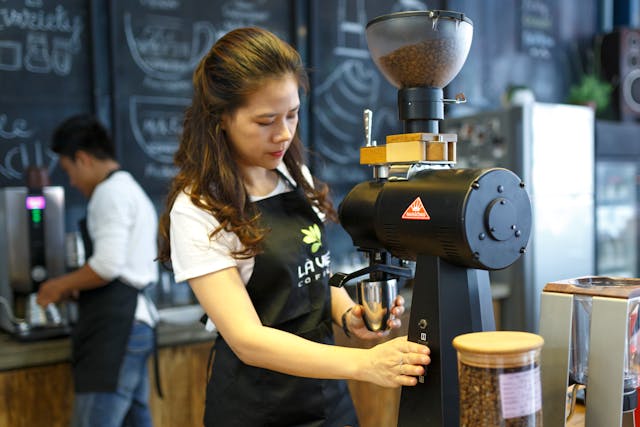
A barista is a person who prepares and serves coffee – often with a special focus on espresso and espresso-based drinks such as cappuccino, caffe latte, flat white, and cortado.
However, a skilled barista does more than just push a button on an espresso machine. The work involves things like adjusting the coffee grinder, brewing espresso, steaming milk, understanding the taste of the coffee, keeping the equipment clean, and delivering a consistent result from cup to cup.
In a coffee shop, the barista therefore combines coffee knowledge, practical skills, and customer service.
What does barista mean?
The word barista comes from Italian.
In Italian, the word is used for a person who works behind a bar and serves drinks. Internationally, the meaning has gradually become closely associated with a person who professionally prepares coffee.
In Denmark, we therefore usually use the term barista for the person behind the coffee bar who works with, among other things, espresso, milk drinks, and coffee brewing.
What does a barista do?
A barista's work tasks vary from coffee shop to coffee shop.
Typical tasks include:
• Adjusting the coffee grinder
• Dosing and brewing espresso
• Preparing cappuccino, latte, flat white, and other coffee drinks
• Steaming and texturing milk
• Latte art
• Manual coffee brewing
• Cleaning the espresso machine and coffee grinder
• Adjusting coffee recipes
• Customer service
• Guidance on coffee and flavor profiles
In a busy coffee shop, workflow and consistency are at least as important as being able to make one really good cup of coffee.
The Specialty Coffee Association describes, among other things, espresso, cleaning routines, brewing, service, extraction control, milk foaming, and workflow as central skills within professional barista work.
What does a barista do in a coffee shop?
A barista often starts the workday by getting the espresso machine and coffee grinder ready.
The coffee grinder usually needs to be adjusted according to the coffee beans being used.
If the espresso runs too fast or too slow, the grind size is adjusted until the espresso tastes the way it should.
Throughout the day, a barista may, among other things, make:
• Espresso
• Americano
• Cappuccino
• Caffe latte
• Flat white
• Cortado
• Latte macchiato
• Espresso macchiato
At some coffee shops, the barista also works with filter coffee, batch brew, V60, AeroPress, or other manual brewing methods.
The barista and espresso
Espresso is a central part of barista work in many coffee shops.
The barista must be able to control, among other things:
Dose – how much coffee is used.
Grind size – how finely the coffee beans are ground.
Yield – how much finished espresso ends up in the cup.
Brew time – how fast the water passes through the coffee puck.
A typical base recipe could be, for example:
18 grams of coffee in
36 grams of espresso out
in approximately 25–35 seconds.
However, that is just a starting point.
A barista's most important task is not to hit a specific number, but to adjust the recipe so that the espresso tastes good.
Why does a barista adjust the coffee grinder?
The coffee grinder's setting has a major impact on the espresso's flow.
If the espresso runs too fast, the barista will typically grind the coffee finer.
If the espresso runs too slowly, the coffee will typically be ground coarser.
The setting may need to be changed throughout the day.
Coffee beans, temperature, humidity, and the age of the coffee can affect how the espresso behaves.
Therefore, a professional espresso grinder is an important tool for the barista.
The barista and milk foaming
A large part of the drinks at a modern coffee shop combine espresso with milk.
The barista must therefore be able to heat and texture the milk.
The goal is often a smooth and uniform microfoam with very small air bubbles.
The desired consistency also depends on the drink.
A cappuccino, for example, may have more foam than a flat white or cortado.
Good milk foaming is not just about latte art. The texture of the milk also affects the mouthfeel and the experience of the coffee.
What is latte art?
Latte art consists of patterns formed when textured milk is poured into espresso.
Classic patterns include, among others:
• Heart
• Tulip
• Rosetta
To create latte art, the espresso and especially the milk must have the right consistency.
However, latte art in itself is not a sign that the coffee tastes good.
A skilled barista prioritizes the taste of the espresso and the texture of the milk first – the presentation comes afterwards.
What should a good barista be able to do?
A good barista doesn't need to know every detail about coffee from the first day on the job.
However, there are some skills that are particularly useful.
Understand espresso
The barista should understand the relationship between dose, grind size, brew time, and yield.
Be able to taste coffee
It is difficult to adjust espresso without tasting the result.
The barista must be able to assess whether the coffee, for example, seems too bitter, thin, sharp, or unbalanced.
Steam milk
The milk must be heated and textured consistently.
Work quickly and organized
In a busy coffee shop, multiple drinks often need to be produced at the same time.
A good workflow makes it easier to maintain quality.
Keep equipment clean
Coffee oils and milk residues affect both hygiene, equipment, and taste.
Cleaning is therefore an important part of barista work.
Talk to customers
A barista also works with people.
This might, for example, be recommending coffee, explaining the difference between drinks, or helping a customer choose between a cappuccino and a flat white.
What is barista coffee?
Barista coffee is not a specific type of coffee bean.
The term is used in different ways and does not have one fixed definition.
Some manufacturers, for example, use "barista" in product names for coffee beans, milk, or coffee equipment.
When talking about coffee made by a barista, it is instead about the preparation itself.
A barista can use:
• Single origin coffee
• Coffee blends
• Light roasted coffee beans
• Medium roasted coffee beans
• Dark roasted coffee beans
The right choice depends on the brewing method and the desired taste.
In other words, there is no special coffee bean that you must use to make "barista coffee".
Which coffee beans does a barista use?
At an espresso bar, coffee beans that work well for espresso are often used.
This can be a blend or a single origin coffee.
Medium roasted coffee beans are popular because they can provide a good balance between sweetness, body, and acidity.
Darker roasts can provide a more intense and roasted flavor profile that stands out clearly in milk drinks.
Light roasted coffee beans can provide more fruity and acidic espressos and are also widespread within modern specialty coffee.
A barista normally adjusts the coffee grinder and espresso recipe to the specific coffee rather than using the exact same setting for all coffee beans.
What equipment does a barista use?
In a coffee shop, the espresso machine and coffee grinder are, of course, central.
In addition, the following are often used:
• Tamper
• Coffee scale
• Milk pitchers
• Knockbox
• WDT tool
• Dosing equipment
• Cleaning brushes
• Cleaning agents
• Thermometer
• Coffee cups and glasses
How much barista equipment is necessary depends on the workplace.
The same applies at home.
You don't need to buy every conceivable piece of barista equipment to make good coffee. Start with good basic equipment and then add products that solve a specific problem.
Can you be a home barista?
Yes.
The term home barista is often used for coffee enthusiasts who work with espresso and other coffee brewing methods at home.
You don't need to work professionally at a coffee shop to learn the same techniques.
As a home barista, you can, for example, practice:
• Adjusting espresso
• Adjusting the coffee grinder
• Steaming milk
• Making latte art
• Working with different coffee beans
• Using different brew ratios
• Tasting coffee systematically
That is precisely one of the advantages of coffee as a hobby: there are always more things to experiment with.
How do you become a barista?
Many baristas learn the trade through practical work at a café or coffee shop.
There are also courses and organized coffee education.
The Specialty Coffee Association offers, for example, Barista Skills at several levels, where they work with, among other things, espresso, milk, cleaning, workflow, and quality.
However, you don't need to start with an education to learn basic barista skills.
If you want to practice at home, you can start by learning:
- How espresso is adjusted
- How the coffee grinder affects the flow
- How milk is steamed
- How coffee is tasted and evaluated
- How the equipment is cleaned correctly
Then you can build up more knowledge over time.
Does a barista have to be able to do latte art?
No.
Latte art is a beautiful and useful skill, but it is only one small part of barista work.
A barista who makes a perfect heart on top of a poorly brewed espresso has not necessarily made a good cappuccino.
First comes:
Good coffee
Correct brewing
Good milk
Consistency
Cleaning
Workflow
Latte art comes after that.
Barista or bartender – what is the difference?
In Danish, barista is used primarily for a person who works with coffee.
A bartender works primarily with drinks in a bar.
The interesting thing is that the Italian word barista originally denotes a person who works behind a bar. The international use of the word has later become closely linked to the coffee profession.
In a Danish coffee shop, "barista" will therefore almost always mean the person who prepares the coffee.
Barista and specialty coffee
A barista can work with both regular coffee and specialty coffee.
Within specialty coffee, there is often extra focus on the coffee's origin, roast, brewing recipe, and flavor profile.
The barista thus functions as the final link between the coffee bean and the finished cup.
Even good coffee beans can be brewed poorly.
Conversely, a skilled barista can get much more out of the coffee by choosing the right grind size, dose, and brewing recipe.
Do you want to become better as a home barista?
You don't need to start with expensive equipment.
Start by learning the basic relationships.
If you make espresso, you can, for example, start with:
18 grams of coffee
36 grams of espresso
approximately 25–35 seconds brew time
Use a coffee scale, taste the result, and adjust the grind size.
When the espresso works, you can start working with milk foam, different coffee beans, and more advanced barista equipment.
It makes much more sense than buying all the equipment first and learning the technique afterwards.
Frequently asked questions about baristas
What is a barista?
A barista is a person who prepares and serves coffee. In modern coffee shops, the barista works especially with espresso, milk drinks, coffee grinders, brewing recipes, and customer service.
What does barista mean?
Barista is an Italian word for a person who works behind a bar. Internationally, the word is used especially for people who professionally prepare coffee.
What does a barista do?
A barista brews coffee, adjusts the coffee grinder, makes espresso, steams milk, cleans equipment, and serves customers. Work tasks vary between different coffee shops.
What is barista coffee?
Barista coffee is not a specific type of coffee. The term is often used as a marketing label or for coffee prepared with barista techniques.
Do you have to be trained to be a barista?
You can learn the barista trade through practical work and courses. There are also structured training programs within coffee and barista skills.
What equipment does a barista use?
The most important tools are typically an espresso machine and a coffee grinder. In addition, items such as a tamper, coffee scale, milk pitchers, knockbox, cleaning equipment, and various dosing tools are used.
What is a home barista?
A home barista is a coffee enthusiast who works with barista techniques at home – for example, espresso, milk foam, latte art, and adjusting the coffee grinder.
Does a barista have to be able to do latte art?
It is not a requirement. Correct espresso, milk texture, cleaning, and consistency are more important than the pattern on top of the coffee.
What is the difference between a barista and a bartender?
In Denmark, a barista works primarily with coffee, while a bartender works primarily with drinks in a bar.