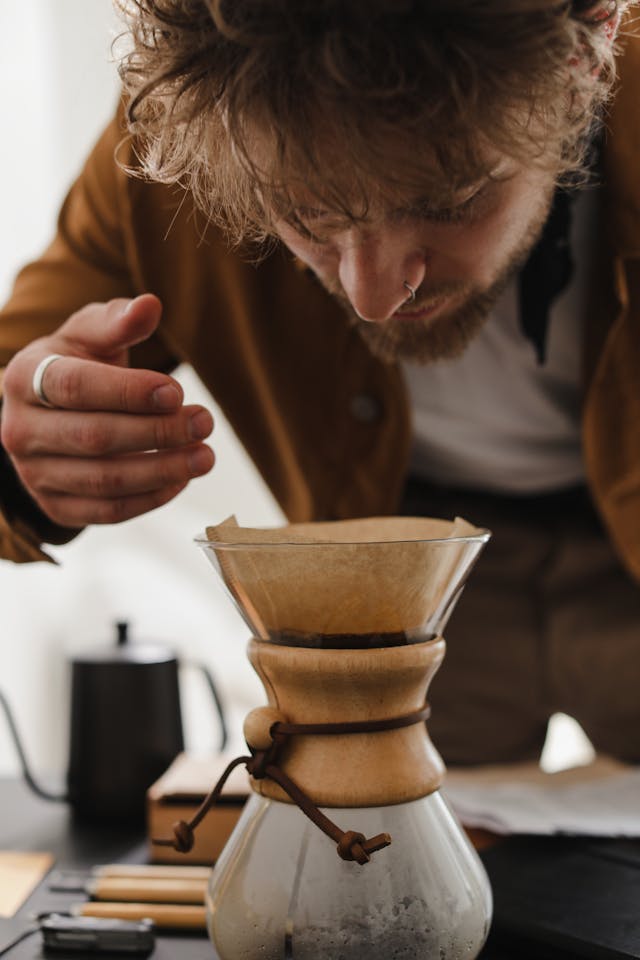
What is aroma?
Aroma is the scent we experience from coffee, food, and beverages.
When we smell freshly brewed coffee, our sense of smell registers a wide range of volatile aromatic compounds released from the coffee. Aroma therefore plays a major role in how we perceive the overall flavor of coffee.
Among other things, it is the aroma that can make a coffee remind us of chocolate, nuts, citrus fruit, berries, flowers, caramel, or spices.
This does not necessarily mean that these ingredients have been added to the coffee. The aromas arise naturally through the coffee bean's properties, processing, roasting, and brewing.
What does aroma mean?
Aroma refers to the scent impressions we register through our sense of smell.
When molecules from, for example, coffee become volatile and move through the air, they can reach the olfactory receptors in the nose.
The brain then interprets the signals as various scent impressions.
That is why you can smell coffee even before you take your first sip.
But the sense of smell also works while you are drinking.
Aromatic compounds can move from the oral cavity up to the nose, which is why aroma contributes significantly to the overall flavor experience.
Is aroma the same as taste?
No.
In everyday language, we often use "taste" to describe the entire experience, but from a sensory perspective, one can distinguish between, among other things, taste, aroma, and mouthfeel.
Taste is primarily registered by taste receptors on the tongue.
Here we work with the basic tastes, among others:
• Sweet
• Sour
• Salty
• Bitter
• Umami
Aroma, on the other hand, is registered through the sense of smell.
When taste, aroma, and other sensory impressions are combined in the brain, we get the overall experience of the coffee's flavor or flavor profile.
This is why coffee can be perceived as much less nuanced if your sense of smell is reduced, for example.
What is aroma in coffee?
In coffee, aroma refers to the scent impressions that come from the coffee's many volatile compounds.
Coffee has a very complex chemistry, and a large number of different compounds can be formed or changed through cultivation, processing, and especially roasting.
Not all compounds have the same sensory significance.
Some exist in relatively large quantities without dominating the aroma, while others can affect the scent experience even in very small concentrations.
The aroma you experience from a cup of coffee is therefore the result of many different substances working together.
Where does coffee aroma come from?
Coffee's aroma begins with the raw coffee bean.
It is influenced by, among other things:
• Coffee variety
• Growing conditions
• Region of origin
• Altitude
• Ripeness at harvest
• Processing method
• Roasting
• Storage
• Grinding
• Brewing method
The roasting process is particularly important because the heating creates a wide range of new aromatic compounds.
This is why raw green coffee beans smell very different from roasted coffee beans.
How is aroma formed during coffee roasting?
During roasting, a series of chemical reactions occur in the coffee bean.
Among the most important are reactions between sugars, amino acids, and other substances in the coffee bean.
Many of the compounds we associate with the scent of roasted coffee are formed here.
This can, for instance, result in aromas perceived as:
chocolate
caramel
roasted nuts
fruit
flowers
spices
toasted bread
and many other nuances.
The roast profile therefore has a major impact on the final aroma.
Light roast coffee and aroma
With light roasting, the coffee's original character typically has more room to shine.
You can therefore often experience aromas in the direction of:
• Citrus
• Berries
• Stone fruit
• Tropical fruit
• Flowers
• Tea-like notes
• Honey
This does not mean that all light-roasted coffees taste fruity.
The specific coffee bean and its processing also have a great impact.
However, light roasting generally provides less dominant roast character than darker roasts.
Medium roast coffee and aroma
Medium roasting often provides a balance between the coffee's original character and the aromas that develop through the roasting process.
Here you might, for example, encounter associations with:
• Caramel
• Chocolate
• Nuts
• Fruit
• Brown sugar
• Spices
This is one of the reasons why medium-roasted coffee can be very versatile.
Both the coffee bean's origin and the roasting itself can be evident in the aroma.
Dark roast coffee and aroma
When coffee is roasted darker, the character of the roast normally becomes more prominent.
The aroma can, for example, be associated with:
• Dark chocolate
• Cocoa
• Roasted nuts
• Caramelized notes
• Spices
• Toasted or smoky character
At the same time, some of the more delicate fruity and floral aromas typically become less prominent.
This does not mean that dark-roasted coffee is better or worse.
It is simply a different aromatic profile.
What does the coffee's origin mean for the aroma?
Where the coffee is grown can have a major impact on its aromatic character.
Climate, altitude, soil, coffee variety, and growing conditions affect the coffee bean.
Therefore, coffee from different regions can be experienced very differently.
For example, some Ethiopian coffees are associated with floral, citrusy, or fruity aromas, while many Brazilian coffees may have more nutty, chocolatey, and caramel characteristics.
These are broad tendencies – not fixed rules.
There are large variations within the same country.
How does processing affect the aroma?
After the coffee cherries are harvested, the fruit surrounding the coffee bean must be removed, and the beans must be dried.
The method can significantly affect the aroma.
Washed coffee
Washed coffee is often associated with a clean and clear flavor profile, where acidity and the coffee's origin character can stand out clearly.
Natural coffee
In the natural process, the coffee cherries are dried with the fruit surrounding the bean.
This can often provide distinct fruity, sweet, or fermented aromas.
Honey process
In the honey process, varying amounts of fruit flesh are left around the bean during drying.
The result can provide different degrees of sweetness, fruitiness, and body.
Again, these are general tendencies. The individual coffee may behave differently.
What is the difference between aroma and fragrance in coffee?
In professional coffee evaluation, one can distinguish between fragrance and aroma.
Fragrance is typically used to describe the scent of the dry, ground coffee before brewing.
Aroma is used to describe the scent from the coffee after water has been added.
This is an interesting difference because the same coffee can smell different before and after brewing.
Try it yourself next time:
First, smell the whole coffee beans.
Then grind the coffee and smell it again.
Finally, add hot water and compare.
You will often experience three different aromatic stages.
Why does coffee smell stronger after grinding?
When coffee beans are ground, their total surface area becomes much larger.
This means that more aromatic compounds can be quickly released into the air.
Therefore, freshly ground coffee can smell much more intense than whole coffee beans.
But it also means that the aroma disappears faster from ground coffee.
This is one of the reasons why we recommend storing coffee as whole beans and grinding it shortly before brewing, if you have the opportunity.
Why does freshly ground coffee smell so good?
When the coffee is freshly ground, many volatile aromatic compounds are released all at once.
Some of these compounds are very volatile and disappear relatively quickly.
Therefore, the intense scent immediately after grinding is often difficult to preserve in ground coffee over a longer period.
Fresh grinding is therefore not just about the ritual of coffee brewing.
It also affects how much of the coffee's aroma you can experience.
How does freshness affect coffee aroma?
Coffee changes after roasting.
Aromatic compounds can gradually disappear or change when coffee beans are stored.
Oxygen, heat, and moisture can accelerate this development.
However, this does not mean that coffee must necessarily be brewed immediately after roasting.
Freshly roasted coffee beans also release carbon dioxide and often benefit from a resting period.
The optimal time depends on, among other things, the coffee and the brewing method.
Good storage is therefore about limiting unnecessary loss of aroma – not about stopping the coffee's natural development completely.
How to store coffee to preserve the aroma?
Store coffee beans:
• Dry
• Sealed
• Away from direct sunlight
• Away from strong heat sources
• At a reasonably stable temperature
A good resealable coffee bag works fine.
You can also use an airtight coffee canister.
If you store whole coffee beans and grind just before brewing, you simultaneously reduce the time the ground coffee's large surface area is exposed to air.
How does the brewing method affect the aroma?
The brewing method affects which substances are extracted, how the coffee is filtered, the temperature, and how you experience the final drink.
Filter coffee
Paper-filtered coffee can provide a clean and clear cup, where the individual flavor and aroma nuances are often easy to distinguish.
Hario V60
V60 provides great control over the extraction and is often used for coffees with clear fruity and floral profiles.
Chemex
Chemex's thicker paper filter can provide a very clean cup with a relatively light mouthfeel.
French press
The metal filter lets more oils and fine particles into the cup and therefore provides a different aroma and flavor experience.
Espresso
Espresso is very concentrated and can provide an intense aroma due to the high concentration of coffee in a small amount of liquid.
There is no one brewing method that provides the "most correct" aroma.
They highlight different sides of the coffee.
What do flavor notes on coffee mean?
When it says, for example:
chocolate, orange, and caramel
on a bag of coffee, it usually does not mean that these ingredients have been added.
The flavor notes describe associations that the coffee can evoke when smelled and tasted.
It works a bit like descriptions of wine.
If a coffee is described as berry-like, it does not mean that the coffee beans have been mixed with berries.
It describes a sensory similarity.
Is aroma in coffee artificially added?
Basically no, when we are talking about ordinary roasted coffee beans.
The aroma you experience in the coffee comes naturally from the coffee bean and the chemical processes during, among other things, processing, roasting, and brewing.
Of course, there are also flavored coffee products where manufacturers add, for example, vanilla, caramel, or hazelnut aroma.
That is a different type of product.
Flavor notes on ordinary specialty coffee do not in themselves mean that aroma has been added.
What is an aromatic coffee?
"Aromatic" basically means that something has a clear or characteristic scent.
When we describe a coffee as very aromatic, it typically means that it has clear and interesting scent impressions.
It does not necessarily mean that the coffee is better.
Some prefer very floral and aromatic coffees, while others prefer more subdued profiles with chocolate and nuts.
Can you train your ability to smell coffee?
Yes.
You normally become better at recognizing aromas when you actively work with them.
Try, for example, to smell:
lemon peel
orange
chocolate
cocoa
roasted nuts
cinnamon
vanilla
fresh berries
and various fruits.
When the brain already has a clear memory of a specific scent, it becomes easier to recognize similar aromas in coffee.
You do not need to be able to identify 50 aromas to enjoy good coffee.
But a little training can make tasting more interesting.
What is the Coffee Taster's Flavor Wheel?
The Coffee Taster's Flavor Wheel is a tool for putting words to the coffee's sensory properties.
The wheel contains broad categories such as, for example:
• Fruit
• Flowers
• Sweet
• Spices
• Nuts and cocoa
• Roasted character
The categories then become more specific further out in the wheel.
The point is not that everyone should experience exactly the same thing.
The wheel provides a common language that makes it easier to describe and compare coffee.
Does caffeine have an aroma?
Caffeine is not what gives coffee its characteristic scent.
Pure caffeine is described as odorless and has a bitter taste.
Coffee's aroma instead comes primarily from the many volatile compounds that are found and formed in the coffee.
Caffeine therefore has significance for coffee in other ways, but it is not the explanation for why freshly roasted or freshly ground coffee beans smell like coffee.
Is decaffeinated coffee less aromatic?
Not necessarily.
Decaffeinated coffee can still have a complex aroma.
The quality depends on, among other things:
• The original coffee bean
• The method of decaffeination
• The roasting
• The freshness
• The brewing
Since caffeine is not the substance that gives coffee its characteristic aroma, less caffeine does not automatically mean less scent.
A good decaffeinated coffee can therefore easily have fruity, sweet, chocolatey, or other clear aromatic properties.
Why does coffee smell better than it tastes?
It is actually possible.
The scent of coffee consists of many volatile compounds that can provide a very complex experience through the nose.
When you drink the coffee, taste, aroma, mouthfeel, temperature, and bitterness come together.
A coffee can therefore have a fantastic scent, but still be brewed in a way that provides a less pleasant taste.
If the coffee smells good but tastes very bitter, sour, or thin, it may be worth adjusting the brewing.
Why can't I smell the coffee's flavor notes?
Flavor notes can be subtle.
You should not necessarily expect a coffee with notes of "orange and chocolate" to smell exactly like a piece of orange and a chocolate bar.
They are associations.
It can help to:
• Let the coffee cool down a little
• Smell the coffee both before and after brewing
• Taste different coffees side by side
• Use freshly ground coffee
• Avoid strong scents around you during the tasting
The differences often become much easier to detect when two different coffees are compared directly.
Aroma is a big part of the coffee experience
When we drink coffee, we experience much more than the basic tastes on the tongue.
The aroma helps create the many nuances that make it possible to experience one coffee as floral and citrusy, and another as chocolatey and nutty.
The coffee bean's origin, processing, roasting, freshness, grinding, and brewing all affect the result.
It is precisely this combination that makes coffee so varied.
Next time you brew coffee, try to smell the beans before grinding, the freshly ground coffee, and the finished brew.
It is a simple way to discover how much of the coffee experience aroma actually makes up.
Frequently asked questions about aroma
What is aroma?
Aroma is a scent impression that is registered through the sense of smell. In coffee, the aroma comes from a complex mixture of volatile compounds.
What is aroma in coffee?
Aroma in coffee is the scents released from the coffee beans and the brewed coffee. They are influenced by, among other things, the coffee's origin, processing, roasting, and brewing.
Are aroma and taste the same thing?
No. Taste is primarily registered on the tongue, while aroma is registered through the sense of smell. Together, they contribute to the overall flavor experience.
Where does coffee aroma come from?
The aroma comes from a wide range of chemical compounds in the coffee. Many aromatic compounds are formed or changed during roasting.
Are flavor notes added to coffee?
Usually not. Flavor notes describe natural sensory associations such as, for example, chocolate, berries, or citrus.
Why does freshly ground coffee smell strong?
Grinding increases the coffee's surface area and makes it easier for volatile aromatic compounds to escape.
Does caffeine have an aroma?
Pure caffeine is odorless and bitter. Caffeine is therefore not the substance that creates coffee's characteristic aroma.
Does decaffeinated coffee have an aroma?
Yes. Decaffeinated coffee can still have a complex aroma because the coffee's aromatic compounds are not the same as caffeine.
How do you preserve coffee's aroma?
Store whole coffee beans in a dry, sealed container protected from heat and direct sunlight. It is best to grind the coffee shortly before brewing.